



Tattoo Removal Results: What Complete Clearance Looks Like

Tattoo Removal Results: What Complete Clearance Looks Like
Content of this Paper
↑
Complete clearance means three things at once: no visible pigment under standard clinical lighting, no palpable change in skin texture, and a tone that matches the surrounding skin. Most before-and-after galleries show only the first. This paper sets out what genuine laser tattoo removal results look like at each stage of a course, which variables decide whether the final 10% of ink clears, and how the doctors at the Institute of Medical Physics measure an outcome rather than estimate it.
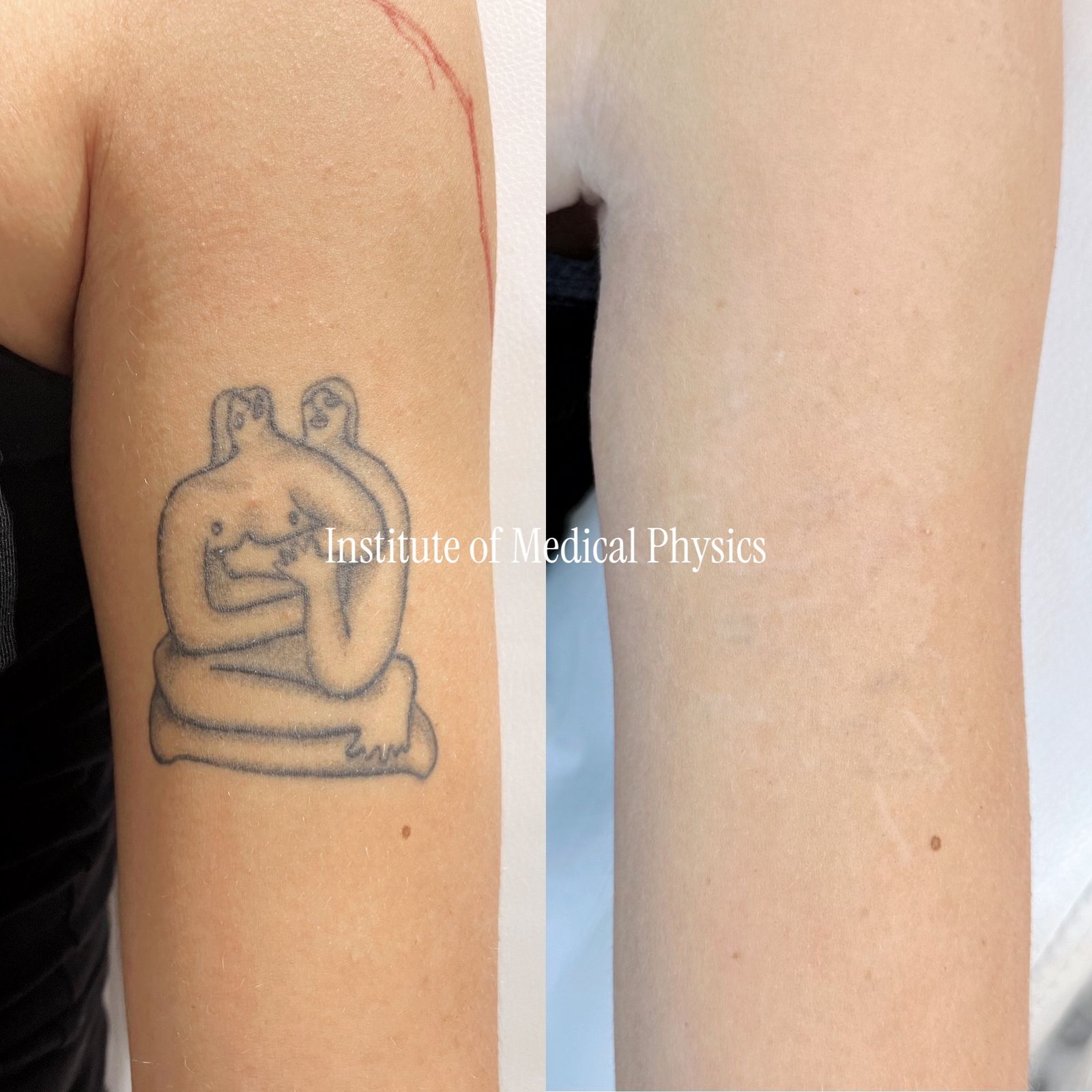
Key Takeaways
- Complete clearance is graded on three axes: no visible pigment, no textural change, and no tone difference from the surrounding skin. A tattoo can be ink-free and still be an incomplete result.
- Judge your result at twelve weeks, not four. Pigment keeps draining for weeks after the final pulse, and published protocols only confirm completion at a three-month follow-up.
- Ink density predicts session count more than anything else. In a 116-patient picosecond study, low-density tattoos averaged 3.2 sessions versus 9.0 for high-density, while tattoo size had no significant effect at all.
- Fading is not linear. The first two sessions remove the most pigment, and the final stretch from 85% to complete often consumes a third of the entire course.
- A plateau at 90% has three known causes: macrophage recapture of fragmented ink, pigment shielded under cover-up layers, or a pulse duration that no longer suits the remaining ink. All three are fixable, but only in a clinic that can change protocol mid-course.
- Ultrasound imaging replaces guesswork. Subdermal scanning shows ink depth, density, and hidden scar tissue before treatment begins, which is why a session estimate should be a range with a stated basis rather than a round number.
What Counts as a Complete Result
Published research defines the endpoint conservatively. In a prospective study of 116 patients treated to full clearance of black tattoos with a 755nm picosecond system, treatment was recorded as finished only when no ink remained in the former tattoo area, verified at a three-month follow-up rather than immediately after the final session.
That three-month gap is not administrative. Pigment continues leaving the dermis for weeks after the last pulse, so a tattoo judged at four weeks always looks worse than the same tattoo judged at twelve. Patients who abandon a course because week four looks unimpressive are frequently walking away from a result that would have arrived on its own.
At the Institute we grade discharge across three axes, and a patient is only signed off when all three are satisfied:
- Pigment: No ink visible at arm's length in daylight, and no residual density on ultrasound.
- Texture: No atrophy, fibrosis, or raised scar tissue on palpation.
- Tone: No post-inflammatory hyperpigmentation or hypopigmentation persisting beyond twelve weeks.
A tattoo can be entirely pigment-free and still represent an incomplete result if the skin left behind is pale, shiny, or indented. That distinction is the single most useful thing to understand before choosing a tattoo removal clinic in London.
How Many Sessions Complete Clearance Actually Takes
Session estimates circulate widely, and most are unsourced. The figures below come from the 116-patient picosecond cohort above, in which the average course to full clearance was 6 sessions with a range of 2 to 20.
Two findings in that dataset overturn common assumptions. Tattoo size had no statistically significant effect on session count, while ink density had by far the largest, so a dense two-centimetre monogram can outlast a sprawling but lightly shaded piece. Patient age and gender showed no significant influence either.
The older Kirby-Desai scale, built on 100 Q-switched cases and still the most widely used predictive tool, reached a correlation coefficient of 0.757 against actual session counts. Useful, but when tested against picosecond outcomes, its predictions deviated from reality by an average of 3.7 sessions. You can run your own tattoo through our Kirby-Desai session calculator for a baseline figure, then read how many sessions tattoo removal takes place for the clinical caveats. Our own Kings Cross caseload typically completes in 4 to 8 sessions, a reduction we attribute to picosecond fragmentation combined with biological therapy and a 4-week interval rather than the conventional 6 to 8.
The Clearance Curve: Why Results Slow Before They Finish
Fading is not linear, and expecting it to be causes more abandoned courses than any side effect. The pattern we see consistently across doctor-led tattoo removal in London runs roughly as follows.
Sessions one and two remove the most pigment by volume and produce the most dramatic photographs. Sessions three to five deliver a visible but shallower improvement, typically taking a tattoo from around 60% cleared to around 85%. The final stretch, from 85% to complete, often consumes a third of the total course. Patients frequently describe this phase as "nothing is happening" when in fact the remaining ink is simply thinner, deeper, and spread over a wider area, so each increment of clearance is less visible than the last.
Judged at session three, almost every course looks like it is succeeding. Judged at session six, the courses that will finish and the courses that will plateau start to separate. That is the point at which protocol needs to change, and a single-laser clinic has nothing left to change it to.
Why Some Tattoos Plateau at 90%
Three mechanisms account for most incomplete tattoo removal results in the UK.
The first is biological. Tattoo pigment is not simply floating in the dermis; it is held inside macrophages. Research published in the Journal of Experimental Medicine demonstrated that when those pigment-laden macrophages die, neighbouring macrophages recapture the released ink rather than allowing it to drain away, a capture-release-recapture cycle that explains both why tattoos persist for decades and why removal is slow. Fragmenting ink is therefore only half the task.
Clearing it depends on macrophage turnover and lymphatic drainage, which is the rationale for the biological therapy we run alongside every session to raise local macrophage activity between visits.
The second is architectural. Layered and cover-up tattoos shield deeper pigment behind newer ink, and no wavelength reaches what it cannot see. The third is technical: a plateau is often the signature of one laser being asked to do the work of four.
Early dense pigment responds to the highest peak pressure a sub-300 picosecond pulse can generate, while residual, morphologically altered ink responds better to a longer 750 picosecond pulse. Our Phantom Pico platform runs four picosecond architectures precisely so that the protocol can move on when the tattoo does.
Ghosting, Shadowing and Texture: The Three Imperfect Endpoints
Not every stalled course is stalled for the same reason, and the correct treatment differs in each case.
- Ghosting is a faint grey outline where dense line work once sat, usually residual pigment at the deepest point of deposition. It responds to continued treatment at adjusted pulse duration, not to more of the same settings.
- Shadowing is discolouration rather than ink. Post-inflammatory hyperpigmentation is a melanocyte response, most common on Fitzpatrick IV to VI skin, and it will not clear with further picosecond passes because there is nothing left to shatter. We treat it with a 1927 nm Thulium protocol and manage hypopigmentation with a 308 nm excimer laser paired with a topical calcineurin inhibitor to stimulate melanocyte function.
- Textural change is fibrosis, usually from the original tattooing or from earlier over-treatment. Scar tissue mechanically traps ink, so we stack fractional CO₂ with picosecond delivery in the same appointment: the CO₂ laser opens microscopic channels through the fibrotic layer, and the picosecond pulse is delivered through them within a five-minute window before the inflammatory cascade closes them. More on the mechanisms behind scarring risk and prevention.
Results on Melanin-Rich Skin
The picosecond cohort cited above excluded Fitzpatrick V and VI entirely on the stated grounds that a 755 nm picosecond wavelength is unsuitable for dark skin. That exclusion is honest science, and it also explains why so much published session data does not describe the patients who walk into a London tattoo removal clinic.
Melanin competes with tattoo ink for laser absorption, so the same fluence that clears a type II arm can burn a type V one. Complete clearance on deeper skin tones remains achievable, but it requires a 1064 nm primary wavelength, conservative fluence escalation, longer assessment at each visit, and in-house rescue protocols for pigmentary complications. Patients weighing this up should read which laser is best for dark skin tattoo removal before booking anywhere.
How We Measure Tattoo Removal Results Rather Than Estimate Them
Every consultation at our Kings Cross clinic begins with subdermal acoustic imaging, a medical ultrasound scan of the tattoo. It shows ink depth and distribution, hyperechoic scar tissue invisible to the naked eye, density variation across the design, and structural changes left by previous treatment elsewhere. We are the only UK clinic using it as standard, and it is the reason our session estimates are given as a range with a stated basis rather than a round number.
Progress is then tracked against standardised photography under fixed lighting and distance, because handheld phone comparisons exaggerate early sessions and understate late ones. Between visits, patients have direct WhatsApp access to the clinical team, which matters most in the 72 hours after a session when a blister or an unexpected reaction needs a decision rather than a wait.
Protecting Your Result Between Sessions
Clinical technique determines the ceiling of your result. Your behaviour between sessions determines how close you get to it.
Keep the area clean and dry for 48 to 72 hours and do not pick blisters or crusts, since disrupted healing is a direct route to textural change. Protect the site with clothing or high-factor sunscreen throughout the course, as ultraviolet exposure on treated skin is the most common trigger for pigmentary shadowing.
Support lymphatic clearance with hydration and normal activity once the initial reaction settles, and treat lower-leg and ankle tattoos as slower by default: circulation there is poorer, healing takes an extra two to three weeks, and pushing the interval tighter raises risk without accelerating clearance. Full detail is set out in our guidance on caring for skin after laser tattoo removal.
This guide is for general information and is not a substitute for a medical consultation. Suitability, session numbers, and outcomes vary by individual. Book a consultation with the team at the Institute of Medical Physics for an assessment of your tattoo and skin type.
Related articles:
Frequently Asked Questions
Can a tattoo be removed completely?
Most black, single-layer tattoos can be cleared completely. In a prospective study of 116 patients treated with a picosecond laser, complete clearance was achieved in every case, taking an average of 6 sessions with a range of 2 to 20. White, pastel, and UV inks may never clear fully, and layered or cosmetic tattoos need specialist assessment before any prediction is made.
Does laser tattoo removal work on all ink colours?
No. Black and dark blue ink absorb laser energy most efficiently and clear fastest. Red responds well to the correct wavelength, while green, yellow, and purple absorb poorly and need more sessions across multiple wavelengths. White ink often contains titanium dioxide, which can oxidise and darken when treated.
How long after the final session should I judge my result?
Wait twelve weeks. Pigment continues to be cleared by the immune system for weeks after the last pulse, and published protocols confirm completion at a three-month follow-up rather than immediately after treatment.
Why has my tattoo stopped fading after several sessions?
A plateau usually means one of three things: pigment trapped beneath a newer layer of ink, macrophage recapture of fragmented pigment, or a laser whose pulse duration no longer suits the remaining ink. All three are addressable, but only in a clinic that can change wavelength or pulse duration mid-course.
Will complete clearance leave the skin looking normal?
In most cases, yes. Correctly delivered picosecond treatment should leave no scarring. Residual hyperpigmentation or hypopigmentation can occur, particularly on Fitzpatrick IV to VI skin, and both are treatable with the correct laser and prescribing protocols.
How many sessions will my tattoo take?
Ink density is the strongest predictor, ranging from an average of 3.2 sessions for low-density work to 9.0 for high-density. Location, tattoo age, and application technique follow. A pre-treatment ultrasound scan gives a far more reliable figure than any online calculator.

Tattoo Removal Results: What Complete Clearance Looks Like
.svg)

Complete clearance means three things at once: no visible pigment under standard clinical lighting, no palpable change in skin texture, and a tone that matches the surrounding skin. Most before-and-after galleries show only the first. This paper sets out what genuine laser tattoo removal results look like at each stage of a course, which variables decide whether the final 10% of ink clears, and how the doctors at the Institute of Medical Physics measure an outcome rather than estimate it.

Key Takeaways
- Complete clearance is graded on three axes: no visible pigment, no textural change, and no tone difference from the surrounding skin. A tattoo can be ink-free and still be an incomplete result.
- Judge your result at twelve weeks, not four. Pigment keeps draining for weeks after the final pulse, and published protocols only confirm completion at a three-month follow-up.
- Ink density predicts session count more than anything else. In a 116-patient picosecond study, low-density tattoos averaged 3.2 sessions versus 9.0 for high-density, while tattoo size had no significant effect at all.
- Fading is not linear. The first two sessions remove the most pigment, and the final stretch from 85% to complete often consumes a third of the entire course.
- A plateau at 90% has three known causes: macrophage recapture of fragmented ink, pigment shielded under cover-up layers, or a pulse duration that no longer suits the remaining ink. All three are fixable, but only in a clinic that can change protocol mid-course.
- Ultrasound imaging replaces guesswork. Subdermal scanning shows ink depth, density, and hidden scar tissue before treatment begins, which is why a session estimate should be a range with a stated basis rather than a round number.
What Counts as a Complete Result
Published research defines the endpoint conservatively. In a prospective study of 116 patients treated to full clearance of black tattoos with a 755nm picosecond system, treatment was recorded as finished only when no ink remained in the former tattoo area, verified at a three-month follow-up rather than immediately after the final session.
That three-month gap is not administrative. Pigment continues leaving the dermis for weeks after the last pulse, so a tattoo judged at four weeks always looks worse than the same tattoo judged at twelve. Patients who abandon a course because week four looks unimpressive are frequently walking away from a result that would have arrived on its own.
At the Institute we grade discharge across three axes, and a patient is only signed off when all three are satisfied:
- Pigment: No ink visible at arm's length in daylight, and no residual density on ultrasound.
- Texture: No atrophy, fibrosis, or raised scar tissue on palpation.
- Tone: No post-inflammatory hyperpigmentation or hypopigmentation persisting beyond twelve weeks.
A tattoo can be entirely pigment-free and still represent an incomplete result if the skin left behind is pale, shiny, or indented. That distinction is the single most useful thing to understand before choosing a tattoo removal clinic in London.
How Many Sessions Complete Clearance Actually Takes
Session estimates circulate widely, and most are unsourced. The figures below come from the 116-patient picosecond cohort above, in which the average course to full clearance was 6 sessions with a range of 2 to 20.
Two findings in that dataset overturn common assumptions. Tattoo size had no statistically significant effect on session count, while ink density had by far the largest, so a dense two-centimetre monogram can outlast a sprawling but lightly shaded piece. Patient age and gender showed no significant influence either.
The older Kirby-Desai scale, built on 100 Q-switched cases and still the most widely used predictive tool, reached a correlation coefficient of 0.757 against actual session counts. Useful, but when tested against picosecond outcomes, its predictions deviated from reality by an average of 3.7 sessions. You can run your own tattoo through our Kirby-Desai session calculator for a baseline figure, then read how many sessions tattoo removal takes place for the clinical caveats. Our own Kings Cross caseload typically completes in 4 to 8 sessions, a reduction we attribute to picosecond fragmentation combined with biological therapy and a 4-week interval rather than the conventional 6 to 8.
The Clearance Curve: Why Results Slow Before They Finish
Fading is not linear, and expecting it to be causes more abandoned courses than any side effect. The pattern we see consistently across doctor-led tattoo removal in London runs roughly as follows.
Sessions one and two remove the most pigment by volume and produce the most dramatic photographs. Sessions three to five deliver a visible but shallower improvement, typically taking a tattoo from around 60% cleared to around 85%. The final stretch, from 85% to complete, often consumes a third of the total course. Patients frequently describe this phase as "nothing is happening" when in fact the remaining ink is simply thinner, deeper, and spread over a wider area, so each increment of clearance is less visible than the last.
Judged at session three, almost every course looks like it is succeeding. Judged at session six, the courses that will finish and the courses that will plateau start to separate. That is the point at which protocol needs to change, and a single-laser clinic has nothing left to change it to.
Why Some Tattoos Plateau at 90%
Three mechanisms account for most incomplete tattoo removal results in the UK.
The first is biological. Tattoo pigment is not simply floating in the dermis; it is held inside macrophages. Research published in the Journal of Experimental Medicine demonstrated that when those pigment-laden macrophages die, neighbouring macrophages recapture the released ink rather than allowing it to drain away, a capture-release-recapture cycle that explains both why tattoos persist for decades and why removal is slow. Fragmenting ink is therefore only half the task.
Clearing it depends on macrophage turnover and lymphatic drainage, which is the rationale for the biological therapy we run alongside every session to raise local macrophage activity between visits.
The second is architectural. Layered and cover-up tattoos shield deeper pigment behind newer ink, and no wavelength reaches what it cannot see. The third is technical: a plateau is often the signature of one laser being asked to do the work of four.
Early dense pigment responds to the highest peak pressure a sub-300 picosecond pulse can generate, while residual, morphologically altered ink responds better to a longer 750 picosecond pulse. Our Phantom Pico platform runs four picosecond architectures precisely so that the protocol can move on when the tattoo does.
Ghosting, Shadowing and Texture: The Three Imperfect Endpoints
Not every stalled course is stalled for the same reason, and the correct treatment differs in each case.
- Ghosting is a faint grey outline where dense line work once sat, usually residual pigment at the deepest point of deposition. It responds to continued treatment at adjusted pulse duration, not to more of the same settings.
- Shadowing is discolouration rather than ink. Post-inflammatory hyperpigmentation is a melanocyte response, most common on Fitzpatrick IV to VI skin, and it will not clear with further picosecond passes because there is nothing left to shatter. We treat it with a 1927 nm Thulium protocol and manage hypopigmentation with a 308 nm excimer laser paired with a topical calcineurin inhibitor to stimulate melanocyte function.
- Textural change is fibrosis, usually from the original tattooing or from earlier over-treatment. Scar tissue mechanically traps ink, so we stack fractional CO₂ with picosecond delivery in the same appointment: the CO₂ laser opens microscopic channels through the fibrotic layer, and the picosecond pulse is delivered through them within a five-minute window before the inflammatory cascade closes them. More on the mechanisms behind scarring risk and prevention.
Results on Melanin-Rich Skin
The picosecond cohort cited above excluded Fitzpatrick V and VI entirely on the stated grounds that a 755 nm picosecond wavelength is unsuitable for dark skin. That exclusion is honest science, and it also explains why so much published session data does not describe the patients who walk into a London tattoo removal clinic.
Melanin competes with tattoo ink for laser absorption, so the same fluence that clears a type II arm can burn a type V one. Complete clearance on deeper skin tones remains achievable, but it requires a 1064 nm primary wavelength, conservative fluence escalation, longer assessment at each visit, and in-house rescue protocols for pigmentary complications. Patients weighing this up should read which laser is best for dark skin tattoo removal before booking anywhere.
How We Measure Tattoo Removal Results Rather Than Estimate Them
Every consultation at our Kings Cross clinic begins with subdermal acoustic imaging, a medical ultrasound scan of the tattoo. It shows ink depth and distribution, hyperechoic scar tissue invisible to the naked eye, density variation across the design, and structural changes left by previous treatment elsewhere. We are the only UK clinic using it as standard, and it is the reason our session estimates are given as a range with a stated basis rather than a round number.
Progress is then tracked against standardised photography under fixed lighting and distance, because handheld phone comparisons exaggerate early sessions and understate late ones. Between visits, patients have direct WhatsApp access to the clinical team, which matters most in the 72 hours after a session when a blister or an unexpected reaction needs a decision rather than a wait.
Protecting Your Result Between Sessions
Clinical technique determines the ceiling of your result. Your behaviour between sessions determines how close you get to it.
Keep the area clean and dry for 48 to 72 hours and do not pick blisters or crusts, since disrupted healing is a direct route to textural change. Protect the site with clothing or high-factor sunscreen throughout the course, as ultraviolet exposure on treated skin is the most common trigger for pigmentary shadowing.
Support lymphatic clearance with hydration and normal activity once the initial reaction settles, and treat lower-leg and ankle tattoos as slower by default: circulation there is poorer, healing takes an extra two to three weeks, and pushing the interval tighter raises risk without accelerating clearance. Full detail is set out in our guidance on caring for skin after laser tattoo removal.
This guide is for general information and is not a substitute for a medical consultation. Suitability, session numbers, and outcomes vary by individual. Book a consultation with the team at the Institute of Medical Physics for an assessment of your tattoo and skin type.
Related articles:
Frequently Asked Questions
Can a tattoo be removed completely?
Most black, single-layer tattoos can be cleared completely. In a prospective study of 116 patients treated with a picosecond laser, complete clearance was achieved in every case, taking an average of 6 sessions with a range of 2 to 20. White, pastel, and UV inks may never clear fully, and layered or cosmetic tattoos need specialist assessment before any prediction is made.
Does laser tattoo removal work on all ink colours?
No. Black and dark blue ink absorb laser energy most efficiently and clear fastest. Red responds well to the correct wavelength, while green, yellow, and purple absorb poorly and need more sessions across multiple wavelengths. White ink often contains titanium dioxide, which can oxidise and darken when treated.
How long after the final session should I judge my result?
Wait twelve weeks. Pigment continues to be cleared by the immune system for weeks after the last pulse, and published protocols confirm completion at a three-month follow-up rather than immediately after treatment.
Why has my tattoo stopped fading after several sessions?
A plateau usually means one of three things: pigment trapped beneath a newer layer of ink, macrophage recapture of fragmented pigment, or a laser whose pulse duration no longer suits the remaining ink. All three are addressable, but only in a clinic that can change wavelength or pulse duration mid-course.
Will complete clearance leave the skin looking normal?
In most cases, yes. Correctly delivered picosecond treatment should leave no scarring. Residual hyperpigmentation or hypopigmentation can occur, particularly on Fitzpatrick IV to VI skin, and both are treatable with the correct laser and prescribing protocols.
How many sessions will my tattoo take?
Ink density is the strongest predictor, ranging from an average of 3.2 sessions for low-density work to 9.0 for high-density. Location, tattoo age, and application technique follow. A pre-treatment ultrasound scan gives a far more reliable figure than any online calculator.
By -
Dr. Saif Chatoo, MBBCh, B.Sc
August 12, 2026


