



Why Choose Professional Laser Tattoo Removal Instead of At-Home Removal Methods?

Why Choose Professional Laser Tattoo Removal Instead of At-Home Removal Methods?
Content of this Paper
↑
A meaningful proportion of the tattoo work carried out at the Institute of Medical Physics is reconstructive rather than elective. Patients arrive at our King's Cross clinic with hypopigmented patches, hypertrophic scars, and ink that has been driven deeper by an attempt to remove it at home. The creams, salt abrasion protocols, and needle kits sold online are not gentler alternatives to clinical laser tattoo removal in London. They are a different category of intervention entirely, one that acts on the wrong layer of skin and has no mechanism for reaching tattoo pigment at all.
This paper explains the anatomy and physics that make at-home removal ineffective, quantifies the documented risks, and sets out what happens instead under medical supervision. It is written by the clinical team behind our laser tattoo removal programme and supports our complete guide to safe and effective tattoo removal in London.
Key Takeaways
- Topicals physically cannot reach tattoo ink. Pigment sits 1 to 2 mm down in the dermis, held inside macrophages, and the FDA has neither approved any DIY removal product nor found evidence that one works.
- Every at-home method removes ink by wounding the skin, and the numbers are one-sided: abrasive approaches scar in virtually all cases, while the NHS puts permanent scarring from professional laser removal at 3 in 100.
- Picosecond treatment finishes in roughly half the sessions. A JAMA Dermatology trial recorded over 75% clearance in every completing patient after an average of 4.25 sessions, against 8.5 to 8.9 with older Q-switched systems.
- Medical registration, not the address, changes the risk profile. The UK has no specific controls on who may offer non-surgical cosmetic procedures, so a prescribing clinician and in-house complication protocols are the real safeguard.
- Damage from failed home attempts is repairable, but only with clinical tools: 1927 nm Thulium for dark patches, a 308 nm excimer laser with prescription topicals for pigment loss, and CO₂ plus picosecond stacking for ink trapped under scar tissue.
- The cost argument reverses on contact with outcomes. A £30 cream that leaves a hypertrophic scar adds correction costs on top of removal, while a fixed upfront price with unlimited sessions and a money-back guarantee aligns the clinic's interest with the fastest possible clearance.
Where Tattoo Ink Sits, and Why Nothing Topical Reaches It
A tattoo needle deposits pigment roughly 1 to 2 mm below the skin surface, into the dermis. The epidermis above it is between 0.05 and 0.1 mm thick, and its outermost layer, the stratum corneum, is a lipid-and-keratin barrier that is measured in tens of micrometres. That barrier exists specifically to stop foreign molecules entering. It works.
Once the ink is in the dermis, it does not sit loose in the tissue. Dermal macrophages engulf the pigment particles and hold them. Research published in the Journal of Experimental Medicine demonstrated that these macrophages are the only cells that capture and retain tattoo pigment and that when one dies, neighbouring macrophages recapture the released particles in a continuous capture, release, recapture cycle. A tattoo persists not because the ink is inert but because the immune system keeps handing it back to itself.
This is the point at which every at-home method fails. A cream applied to the stratum corneum is separated from the pigment by an intact epidermis and by the cell membranes of the macrophages holding it. It cannot dissolve what it cannot touch. The only mechanism available to a topical agent is to injure the epidermis and hope that inflammation drags some pigment upward, which is exactly what happens and exactly why it scars.
The Four At-Home Methods and What Each One Actually Does
Removal creams and DIY kits
The US Food and Drug Administration has neither approved nor cleared any do-it-yourself tattoo removal ointment, cream, or kit and states it is not aware of clinical evidence that any of them work. The agency warns that these products may instead produce rashes, burning, scarring, and changes in skin pigmentation. Typical formulations contain retinol, hydroquinone-style bleaching agents, or acid exfoliants: compounds that resurface the epidermis and nothing more.
Salabrasion and sandpaper abrasion
This is the oldest technique in the literature and the crudest. A peer-reviewed review of tattoo removal methods indexed on PubMed Central records that with abrasive approaches there is virtually always some degree of scarring, loss of normal skin pigment, and residual tattoo remaining. The procedure aerosolises blood and tissue, and on non-facial skin the scarring risk is described as significant even when performed by a physician.
Trichloroacetic acid and glycollic peels
TCA is a legitimate dermatological agent at controlled concentrations. Applied at home to a tattoo, it is uncontrolled by definition. Depth of penetration determines whether the outcome is a peel or a full-thickness chemical burn, and depth cannot be judged by eye.
Saline tattoo removal and needle kits
Marketed as natural, this method re-tattoos the area with hypertonic saline to force an osmotic wound. It reopens the dermis, introduces infection risk, and leaves scar tissue that mechanically encapsulates the remaining ink, making later laser treatment measurably harder.
That final row is the comparison that matters. The NHS puts the permanent scarring risk from professional laser removal at 3 in 100 patients. Every non-laser method above scars most of the time.
What Doctor-Led Removal Actually Involves
The word "professional" is doing a great deal of work in most marketing copy. In practice, a serious tattoo removal clinic London patients can rely on is distinguished by four things: diagnostic imaging before treatment, wavelength and pulse selection matched to the ink, a clinician with prescribing authority present in the room, and an in-house route to correct complications.
Every consultation at the Institute begins with medical-grade subdermal acoustic imaging. The ultrasound scan shows ink depth and distribution, density variation, and, critically for anyone who has attempted removal at home, subsurface fibrosis that is invisible to the naked eye. Treating scarred skin as though it were normal skin is the single most common technical error we correct.
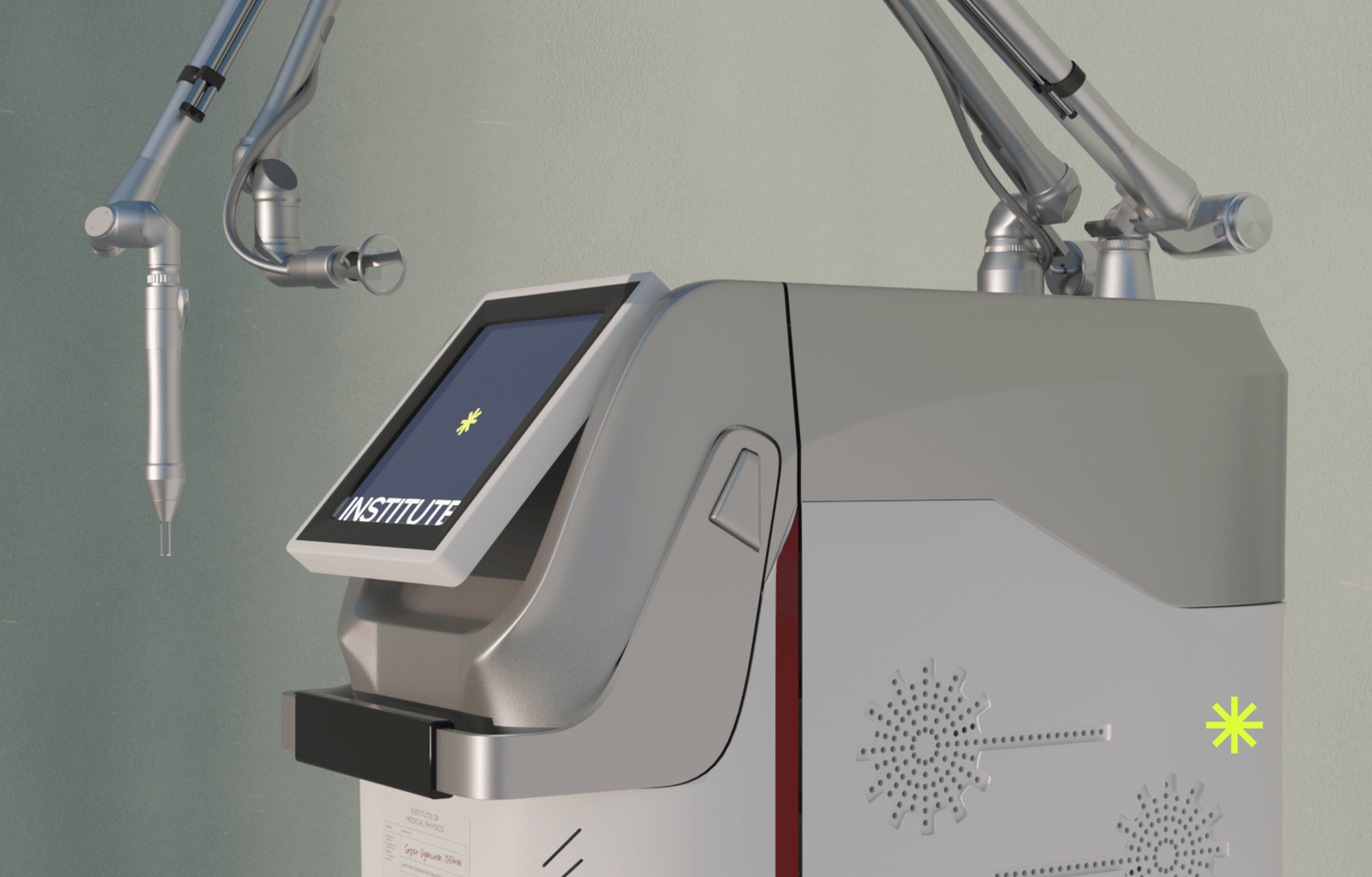
Treatment is then delivered with the Phantom™ system, developed in our San Marino laboratory: eight laser platforms spanning nine therapeutic wavelengths, with the fastest pulse of 200 picoseconds and a peak power of 4.19 gigawatts. Peak power is the variable that fragments ink.
Because peak power is pulse energy divided by pulse duration, compressing a pulse into 200 picoseconds generates the photoacoustic pressure required to shatter dense, early-stage pigment. Four distinct picosecond architectures are used across a course, from that 200 ps pulse down to a longer 750 ps pulse that performs better on residual, morphologically altered ink. Pico laser tattoo removal London providers who operate a single device cannot make that switch, which is why their patients plateau.
A prospective trial in JAMA Dermatology recorded greater than 75% clearance in every patient who completed the study, after an average of 4.25 picosecond sessions, against the 8.5 to 8.9 sessions historically needed with Q-switched systems. The same trial reported hypopigmentation in 20% and hyperpigmentation in 13% of patients at three months, which is precisely why the clinician matters as much as the device.
Between sessions, we use a biological therapy protocol that stimulates local macrophage activity so that more of each session's fragmented pigment is cleared before the next treatment. That is what allows a 4-week interval where most clinics require 6 to 8 weeks, and it follows directly from the capture-release biology described above.
The Cost Argument, Reversed
At-home removal is chosen almost entirely on price. The arithmetic rarely survives contact with the outcome.
The NHS notes that private tattoo removal ranges from around £50 for a single session on a small tattoo to more than £1,000 across a full course and that the procedure is rarely funded by the NHS. Our own pricing starts at £750 upfront for tattoos up to 5 cm², covering unlimited sessions across a two-year period, with a money-back guarantee if clearance is not achieved.
A £30 cream that produces a hypertrophic scar does not save £720. It converts a treatable tattoo into a treatable tattoo plus a permanent scar, and scar revision is neither quick nor cheap.
There is also a regulatory dimension. The UK House of Commons Library confirms there are no specific controls on who may offer non-surgical cosmetic procedures in England. The gap between an unregulated high-street operator and an unregulated bathroom is smaller than most patients assume. Medical registration, not the address, is what changes the risk profile.
Repairing At-Home Damage
Tattoo removal specialists London patients who seek out after a failed home attempt are being asked to solve two problems at once: the remaining ink and the injury inflicted on the skin above it.
For post-inflammatory hyperpigmentation, we use a 1927 nm Thulium laser protocol with published efficacy in Fitzpatrick types IV to VI. For hypopigmentation, where melanocyte function has been lost, we combine the 308 nm XeCl excimer laser with a topical calcineurin inhibitor to stimulate repigmentation, a protocol that requires prescribing authority no beauty clinic holds.
Where scar tissue has encapsulated the ink, fractional CO₂ laser resurfacing creates microchannels through the fibrosis, and picosecond energy is delivered through those channels within a five-minute window before the inflammatory cascade closes them. This treats the trapped pigment and the fibrosis in the same session.
If You Have Already Started
Stop applying the product. Do not attempt to abrade, peel, or re-wrap the area, and do not layer a second method on top of the first. Photograph the site in consistent lighting, note what was applied and for how long, and allow the skin at least four weeks to settle before assessment: fresh inflammation obscures the true baseline on ultrasound.
Bring the packaging or product name to consultation. Hydroquinone-containing and retinoid-containing products alter melanocyte behaviour, and that changes the fluence we can safely use on the first pass. Book an assessment that includes imaging rather than a visual quotation, and ask directly whether the clinic can treat pigmentary complications in-house if they arise. If the answer is vague, the treatment will be too.
Speak to the clinical team.
If you are considering removal, or you have already tried something from a bottle, the useful next step is an assessment that looks beneath the skin rather than at it. Our doctor-led tattoo removal London service operates from our flagship clinic at King's Cross St Pancras, where every session is delivered by a physician. You can book a consultation directly and browse the tattoo removal knowledge base.
This guide is for general information and is not a substitute for a medical consultation. Suitability, session numbers, and outcomes vary by individual. Book a consultation with the team at the Institute of Medical Physics for an assessment of your tattoo and skin type.
Related articles:
Frequently Asked Questions
Do at-home tattoo removal creams work?
No. The US Food and Drug Administration has not approved or cleared any do-it-yourself tattoo removal cream, ointment, or kit and reports no awareness of clinical evidence that they work. Tattoo ink sits in the dermis, roughly 1 to 2 mm below the surface, inside dermal macrophages. Topical creams act only on the stratum corneum and physically cannot reach it. They may cause rashes, burning, scarring, and permanent pigment changes.
Is at-home tattoo removal dangerous?
Yes. Salabrasion, sandpaper abrasion, home acid peels, and saline needle kits all work by wounding the skin. Published reviews of abrasive tattoo removal report that scarring, pigment loss, and residual ink occur in almost every case. Home methods also carry infection risk and can create fibrosis that encapsulates the ink, making subsequent professional removal slower and more difficult.
Can a tattoo be removed without a laser?
Only by surgical excision, which exchanges the tattoo for a scar, or by dermabrasion, which scars in almost all cases and rarely clears the pigment completely. Selective photoacoustic thermolysis using a picosecond laser is the only method that targets ink while leaving surrounding tissue essentially intact, which is why it is the clinical standard for tattoo removal London-wide.
Will at-home removal make professional laser treatment harder?
Yes, in most cases. Scar tissue mechanically traps ink and blocks laser energy, and damaged melanocytes narrow the safe treatment window. At the Institute we address this with subdermal acoustic imaging to map the fibrosis, followed by a CO₂ and picosecond stacking protocol that opens channels through scar tissue so the laser can reach encapsulated pigment.
How much does professional tattoo removal cost compared with at-home methods?
The NHS reports private laser removal costs ranging from about £50 for a single small-tattoo session to over £1,000 for a full course, and the procedure is rarely funded on the NHS. The institute charges from £750 upfront for tattoos up to 5 cm², with unlimited sessions over two years and a money-back guarantee. A failed at-home attempt does not remove this cost. It adds the cost of scar and pigment correction on top.
Is professional laser tattoo removal safe for dark skin?
Yes, with the correct protocol. The NHS reports a permanent scarring rate of 3 in 100 for laser removal generally. In Fitzpatrick types IV to VI, epidermal melanin competes with tattoo ink for laser absorption, so we use 1064 nm as the primary wavelength, conservative fluences, and in-house 1927 nm Thulium and Excimer protocols if pigmentary reactions emerge. At-home methods offer no equivalent safeguard and carry a substantially higher dyspigmentation risk in darker skin.

Why Choose Professional Laser Tattoo Removal Instead of At-Home Removal Methods?
.svg)

A meaningful proportion of the tattoo work carried out at the Institute of Medical Physics is reconstructive rather than elective. Patients arrive at our King's Cross clinic with hypopigmented patches, hypertrophic scars, and ink that has been driven deeper by an attempt to remove it at home. The creams, salt abrasion protocols, and needle kits sold online are not gentler alternatives to clinical laser tattoo removal in London. They are a different category of intervention entirely, one that acts on the wrong layer of skin and has no mechanism for reaching tattoo pigment at all.
This paper explains the anatomy and physics that make at-home removal ineffective, quantifies the documented risks, and sets out what happens instead under medical supervision. It is written by the clinical team behind our laser tattoo removal programme and supports our complete guide to safe and effective tattoo removal in London.

Key Takeaways
- Topicals physically cannot reach tattoo ink. Pigment sits 1 to 2 mm down in the dermis, held inside macrophages, and the FDA has neither approved any DIY removal product nor found evidence that one works.
- Every at-home method removes ink by wounding the skin, and the numbers are one-sided: abrasive approaches scar in virtually all cases, while the NHS puts permanent scarring from professional laser removal at 3 in 100.
- Picosecond treatment finishes in roughly half the sessions. A JAMA Dermatology trial recorded over 75% clearance in every completing patient after an average of 4.25 sessions, against 8.5 to 8.9 with older Q-switched systems.
- Medical registration, not the address, changes the risk profile. The UK has no specific controls on who may offer non-surgical cosmetic procedures, so a prescribing clinician and in-house complication protocols are the real safeguard.
- Damage from failed home attempts is repairable, but only with clinical tools: 1927 nm Thulium for dark patches, a 308 nm excimer laser with prescription topicals for pigment loss, and CO₂ plus picosecond stacking for ink trapped under scar tissue.
- The cost argument reverses on contact with outcomes. A £30 cream that leaves a hypertrophic scar adds correction costs on top of removal, while a fixed upfront price with unlimited sessions and a money-back guarantee aligns the clinic's interest with the fastest possible clearance.
Where Tattoo Ink Sits, and Why Nothing Topical Reaches It
A tattoo needle deposits pigment roughly 1 to 2 mm below the skin surface, into the dermis. The epidermis above it is between 0.05 and 0.1 mm thick, and its outermost layer, the stratum corneum, is a lipid-and-keratin barrier that is measured in tens of micrometres. That barrier exists specifically to stop foreign molecules entering. It works.
Once the ink is in the dermis, it does not sit loose in the tissue. Dermal macrophages engulf the pigment particles and hold them. Research published in the Journal of Experimental Medicine demonstrated that these macrophages are the only cells that capture and retain tattoo pigment and that when one dies, neighbouring macrophages recapture the released particles in a continuous capture, release, recapture cycle. A tattoo persists not because the ink is inert but because the immune system keeps handing it back to itself.
This is the point at which every at-home method fails. A cream applied to the stratum corneum is separated from the pigment by an intact epidermis and by the cell membranes of the macrophages holding it. It cannot dissolve what it cannot touch. The only mechanism available to a topical agent is to injure the epidermis and hope that inflammation drags some pigment upward, which is exactly what happens and exactly why it scars.
The Four At-Home Methods and What Each One Actually Does
Removal creams and DIY kits
The US Food and Drug Administration has neither approved nor cleared any do-it-yourself tattoo removal ointment, cream, or kit and states it is not aware of clinical evidence that any of them work. The agency warns that these products may instead produce rashes, burning, scarring, and changes in skin pigmentation. Typical formulations contain retinol, hydroquinone-style bleaching agents, or acid exfoliants: compounds that resurface the epidermis and nothing more.
Salabrasion and sandpaper abrasion
This is the oldest technique in the literature and the crudest. A peer-reviewed review of tattoo removal methods indexed on PubMed Central records that with abrasive approaches there is virtually always some degree of scarring, loss of normal skin pigment, and residual tattoo remaining. The procedure aerosolises blood and tissue, and on non-facial skin the scarring risk is described as significant even when performed by a physician.
Trichloroacetic acid and glycollic peels
TCA is a legitimate dermatological agent at controlled concentrations. Applied at home to a tattoo, it is uncontrolled by definition. Depth of penetration determines whether the outcome is a peel or a full-thickness chemical burn, and depth cannot be judged by eye.
Saline tattoo removal and needle kits
Marketed as natural, this method re-tattoos the area with hypertonic saline to force an osmotic wound. It reopens the dermis, introduces infection risk, and leaves scar tissue that mechanically encapsulates the remaining ink, making later laser treatment measurably harder.
That final row is the comparison that matters. The NHS puts the permanent scarring risk from professional laser removal at 3 in 100 patients. Every non-laser method above scars most of the time.
What Doctor-Led Removal Actually Involves
The word "professional" is doing a great deal of work in most marketing copy. In practice, a serious tattoo removal clinic London patients can rely on is distinguished by four things: diagnostic imaging before treatment, wavelength and pulse selection matched to the ink, a clinician with prescribing authority present in the room, and an in-house route to correct complications.
Every consultation at the Institute begins with medical-grade subdermal acoustic imaging. The ultrasound scan shows ink depth and distribution, density variation, and, critically for anyone who has attempted removal at home, subsurface fibrosis that is invisible to the naked eye. Treating scarred skin as though it were normal skin is the single most common technical error we correct.
Treatment is then delivered with the Phantom™ system, developed in our San Marino laboratory: eight laser platforms spanning nine therapeutic wavelengths, with the fastest pulse of 200 picoseconds and a peak power of 4.19 gigawatts. Peak power is the variable that fragments ink.
Because peak power is pulse energy divided by pulse duration, compressing a pulse into 200 picoseconds generates the photoacoustic pressure required to shatter dense, early-stage pigment. Four distinct picosecond architectures are used across a course, from that 200 ps pulse down to a longer 750 ps pulse that performs better on residual, morphologically altered ink. Pico laser tattoo removal London providers who operate a single device cannot make that switch, which is why their patients plateau.
A prospective trial in JAMA Dermatology recorded greater than 75% clearance in every patient who completed the study, after an average of 4.25 picosecond sessions, against the 8.5 to 8.9 sessions historically needed with Q-switched systems. The same trial reported hypopigmentation in 20% and hyperpigmentation in 13% of patients at three months, which is precisely why the clinician matters as much as the device.
Between sessions, we use a biological therapy protocol that stimulates local macrophage activity so that more of each session's fragmented pigment is cleared before the next treatment. That is what allows a 4-week interval where most clinics require 6 to 8 weeks, and it follows directly from the capture-release biology described above.
The Cost Argument, Reversed
At-home removal is chosen almost entirely on price. The arithmetic rarely survives contact with the outcome.
The NHS notes that private tattoo removal ranges from around £50 for a single session on a small tattoo to more than £1,000 across a full course and that the procedure is rarely funded by the NHS. Our own pricing starts at £750 upfront for tattoos up to 5 cm², covering unlimited sessions across a two-year period, with a money-back guarantee if clearance is not achieved.
A £30 cream that produces a hypertrophic scar does not save £720. It converts a treatable tattoo into a treatable tattoo plus a permanent scar, and scar revision is neither quick nor cheap.
There is also a regulatory dimension. The UK House of Commons Library confirms there are no specific controls on who may offer non-surgical cosmetic procedures in England. The gap between an unregulated high-street operator and an unregulated bathroom is smaller than most patients assume. Medical registration, not the address, is what changes the risk profile.
Repairing At-Home Damage
Tattoo removal specialists London patients who seek out after a failed home attempt are being asked to solve two problems at once: the remaining ink and the injury inflicted on the skin above it.
For post-inflammatory hyperpigmentation, we use a 1927 nm Thulium laser protocol with published efficacy in Fitzpatrick types IV to VI. For hypopigmentation, where melanocyte function has been lost, we combine the 308 nm XeCl excimer laser with a topical calcineurin inhibitor to stimulate repigmentation, a protocol that requires prescribing authority no beauty clinic holds.
Where scar tissue has encapsulated the ink, fractional CO₂ laser resurfacing creates microchannels through the fibrosis, and picosecond energy is delivered through those channels within a five-minute window before the inflammatory cascade closes them. This treats the trapped pigment and the fibrosis in the same session.
If You Have Already Started
Stop applying the product. Do not attempt to abrade, peel, or re-wrap the area, and do not layer a second method on top of the first. Photograph the site in consistent lighting, note what was applied and for how long, and allow the skin at least four weeks to settle before assessment: fresh inflammation obscures the true baseline on ultrasound.
Bring the packaging or product name to consultation. Hydroquinone-containing and retinoid-containing products alter melanocyte behaviour, and that changes the fluence we can safely use on the first pass. Book an assessment that includes imaging rather than a visual quotation, and ask directly whether the clinic can treat pigmentary complications in-house if they arise. If the answer is vague, the treatment will be too.
Speak to the clinical team.
If you are considering removal, or you have already tried something from a bottle, the useful next step is an assessment that looks beneath the skin rather than at it. Our doctor-led tattoo removal London service operates from our flagship clinic at King's Cross St Pancras, where every session is delivered by a physician. You can book a consultation directly and browse the tattoo removal knowledge base.
This guide is for general information and is not a substitute for a medical consultation. Suitability, session numbers, and outcomes vary by individual. Book a consultation with the team at the Institute of Medical Physics for an assessment of your tattoo and skin type.
Related articles:
Frequently Asked Questions
Do at-home tattoo removal creams work?
No. The US Food and Drug Administration has not approved or cleared any do-it-yourself tattoo removal cream, ointment, or kit and reports no awareness of clinical evidence that they work. Tattoo ink sits in the dermis, roughly 1 to 2 mm below the surface, inside dermal macrophages. Topical creams act only on the stratum corneum and physically cannot reach it. They may cause rashes, burning, scarring, and permanent pigment changes.
Is at-home tattoo removal dangerous?
Yes. Salabrasion, sandpaper abrasion, home acid peels, and saline needle kits all work by wounding the skin. Published reviews of abrasive tattoo removal report that scarring, pigment loss, and residual ink occur in almost every case. Home methods also carry infection risk and can create fibrosis that encapsulates the ink, making subsequent professional removal slower and more difficult.
Can a tattoo be removed without a laser?
Only by surgical excision, which exchanges the tattoo for a scar, or by dermabrasion, which scars in almost all cases and rarely clears the pigment completely. Selective photoacoustic thermolysis using a picosecond laser is the only method that targets ink while leaving surrounding tissue essentially intact, which is why it is the clinical standard for tattoo removal London-wide.
Will at-home removal make professional laser treatment harder?
Yes, in most cases. Scar tissue mechanically traps ink and blocks laser energy, and damaged melanocytes narrow the safe treatment window. At the Institute we address this with subdermal acoustic imaging to map the fibrosis, followed by a CO₂ and picosecond stacking protocol that opens channels through scar tissue so the laser can reach encapsulated pigment.
How much does professional tattoo removal cost compared with at-home methods?
The NHS reports private laser removal costs ranging from about £50 for a single small-tattoo session to over £1,000 for a full course, and the procedure is rarely funded on the NHS. The institute charges from £750 upfront for tattoos up to 5 cm², with unlimited sessions over two years and a money-back guarantee. A failed at-home attempt does not remove this cost. It adds the cost of scar and pigment correction on top.
Is professional laser tattoo removal safe for dark skin?
Yes, with the correct protocol. The NHS reports a permanent scarring rate of 3 in 100 for laser removal generally. In Fitzpatrick types IV to VI, epidermal melanin competes with tattoo ink for laser absorption, so we use 1064 nm as the primary wavelength, conservative fluences, and in-house 1927 nm Thulium and Excimer protocols if pigmentary reactions emerge. At-home methods offer no equivalent safeguard and carry a substantially higher dyspigmentation risk in darker skin.
By -
Dr. Saif Chatoo, MBBCh, B.Sc
August 12, 2026


