



Tattoo Removal in London: The Complete Guide to Safe & Effective Laser Removal

Tattoo Removal in London: The Complete Guide to Safe & Effective Laser Removal
Content of this Paper
↑
Quick Answer: Laser tattoo removal shatters ink with ultra-fast light pulses so your immune system can clear it naturally. With modern picosecond lasers under medical supervision, most tattoos clear in 4 to 8 sessions spaced 4 weeks apart. At the Institute of Medical Physics in Kings Cross, London, pricing starts at £750 upfront for unlimited sessions over 2 years.
The gap between what this technology can achieve and what most patients actually receive remains enormous, and that gap is where almost every poor outcome we see begins. This guide from the doctors at the Institute of Medical Physics sets out the clinical reality: how laser tattoo removal works, what it costs, how long it takes, and how to choose a London clinic that delivers genuinely good outcomes.
See our laser tattoo removal in London page for prices and bookings.
Written by Dr Saif Chatoo, MBBCh, B.Sc., Medical Director, GMC-registered physician (GMC 8010191).
Key Takeaways
- Modern picosecond lasers fire 1,000 times faster than older Q-switched systems, clearing most tattoos in 4 to 8 sessions instead of 10 to 20.
- Black ink clears fastest. Blue, green, layered, and cosmetic tattoos need specialist assessment and more sessions.
- Medical supervision matters: non-medical clinics in the UK operate outside CQC oversight, with documented risks of burns, hypopigmentation, and scarring.
- A single laser is rarely enough. Different pulse durations and wavelengths are needed at different stages, which is why single-system clinics often plateau early.
- Scarred skin and Fitzpatrick IV-VI tones need specialist protocols, including CO₂ + Pico stacking and conservative 1064 nm wavelength settings.
- Pricing structure reveals clinic incentives. A fixed upfront price with unlimited sessions aligns the clinic's interest with the patient's: the fastest possible clearance.
How Does Laser Tattoo Removal Work?
Laser tattoo removal works by selective photoacoustic thermolysis. lysis: a pulse of light lasting trillionths of a second shatters tattoo ink into fragments small enough for the immune system to clear, while leaving the surrounding skin largely untouched. That is why modern treatment can remove pigment without scarring.
Pulse duration is the variable that decides everything. Older Q-switched lasers fire in nanoseconds; modern picosecond systems fire roughly 1,000 times faster, fragmenting pigment far more efficiently.
A prospective trial published in JAMA Dermatology recorded greater than 75% clearance in 100% of completing patients after an average of 4.25 picosecond sessions, versus the 8.5 to 8.9 sessions historically required by Q-switched lasers. The same trial reported hypopigmentation in 20% and hyperpigmentation in 13% of patients at three months: a reminder that even best-in-class technology carries adverse-event rates an experienced clinician must manage.
Which Tattoos Can Be Removed with Laser?
Black, single-layer tattoos respond fastest, typically clearing in 4 to 6 sessions. Coloured, layered, cosmetic, and white or UV inks take longer or need specialist assessment before treatment begins.
NHS patient guidance confirms this pattern: according to Sandwell and West Birmingham NHS Trust, black, blue, and red pigments respond well, while green, yellow, and purple absorb laser energy less efficiently.
Layered tattoos are the most underestimated category. New ink absorbs laser energy first, leaving deeper pigment untouched, which is why patients with eight or more sessions elsewhere often arrive with substantial pigment remaining.
How Many Sessions Does Laser Tattoo Removal Take?
Most London clinics quote 10 to 20 sessions. At the Institute of Medical Physics in Kings Cross, complete clearance typically takes 4 to 8 sessions.
Three factors drive that difference: picosecond photoacoustic shattering produces smaller fragments that clear faster, biological therapy between sessions accelerates immune clearance, and a multi-system laser arsenal lets the physician adapt the protocol at every visit based on how the tattoo is actually responding.
How Much Does Laser Tattoo Removal Cost in London?
Most London clinics price tattoo removal per session, which means the clinic earns more the longer removal takes. The Institute of Medical Physics charges one fixed upfront price by tattoo size: from £750 for tattoos up to 5cm², covering unlimited sessions over a 2-year period (up to 24 monthly sessions), with monthly instalments available.
A money-back guarantee applies if clearance is not achieved within the treatment period. When a clinic earns more per extra session, the incentive to clear quickly disappears; a fixed-price model removes that conflict.
What Happens After Each Session? The Healing Timeline Week by Week
Recovery from a single session is more predictable than most patients expect when treatment is delivered correctly. Most skin settles within 4 weeks, which is when the next session can safely begin.
Tattoos on the lower legs and ankles, where circulation is slower, may take an extra two to three weeks to settle. Rushing schedules tighter than this rarely accelerates clearance and often raises the risk of pigmentary side effects.
Is Laser Tattoo Removal Safe? Why Doctor-Led Treatment Matters
Laser tattoo removal is safe when a trained clinician matches wavelength, pulse duration, and fluence to your skin type. Safety varies sharply by provider: the UK House of Commons Library confirms there are no specific controls on who can offer non-surgical cosmetic procedures in England, and most providers operate outside CQC oversight.
Documented risks at non-medical clinics include burns, hypopigmentation, paradoxical darkening, and scarring requiring corrective treatment. A specialised doctor-led setting changes four things in practice:
- Diagnostic accuracy before treatment: Fitzpatrick skin type, melanin density, prior scarring, and underlying dermatological conditions all alter correct laser settings. A non-medical operator working from a fixed protocol cannot adapt the way a clinician can.
- Real-time response to complications: Blistering, infection, and immune reactions are managed safely if recognised within minutes. Most non-medical clinics simply send the patient home.
- Correction of failed removals: A meaningful share of our caseload at the Kings Cross clinic is reconstructive, treating patients whose previous course of laser tattoo removal in London produced scarring or stalled clearance.
- Clear, scientific communication: Honest technical explanations and correct treatment expectations from the first consultation.
What If Something Goes Wrong? Treating Pigmentary Complications
Tattoo removal is not just about breaking down ink; a clinic must also be able to treat side effects when they occur. The Institute of Medical Physics uses a 1927nm Thulium laser protocol for post-inflammatory hyperpigmentation, with published efficacy in Fitzpatrick types IV-VI, and an Excimer + Tacrolimus protocol for hypopigmentation, combining the 308nm XeCI Excimer laser with a topical calcineurin inhibitor to stimulate repigmentation.
Patients who develop these reactions elsewhere come to us looking for a team with the technology and prescribing authority to reverse them.
Why Isn't One Laser Enough?
Different stages of removal need different pulse durations and wavelengths, so a clinic operating a single system will often plateau before clearance is complete. The laser arsenal a clinic operates tells you more about likely outcomes than any marketing claim.
Inside the Phantom™ System: Eight Platforms, Nine Wavelengths
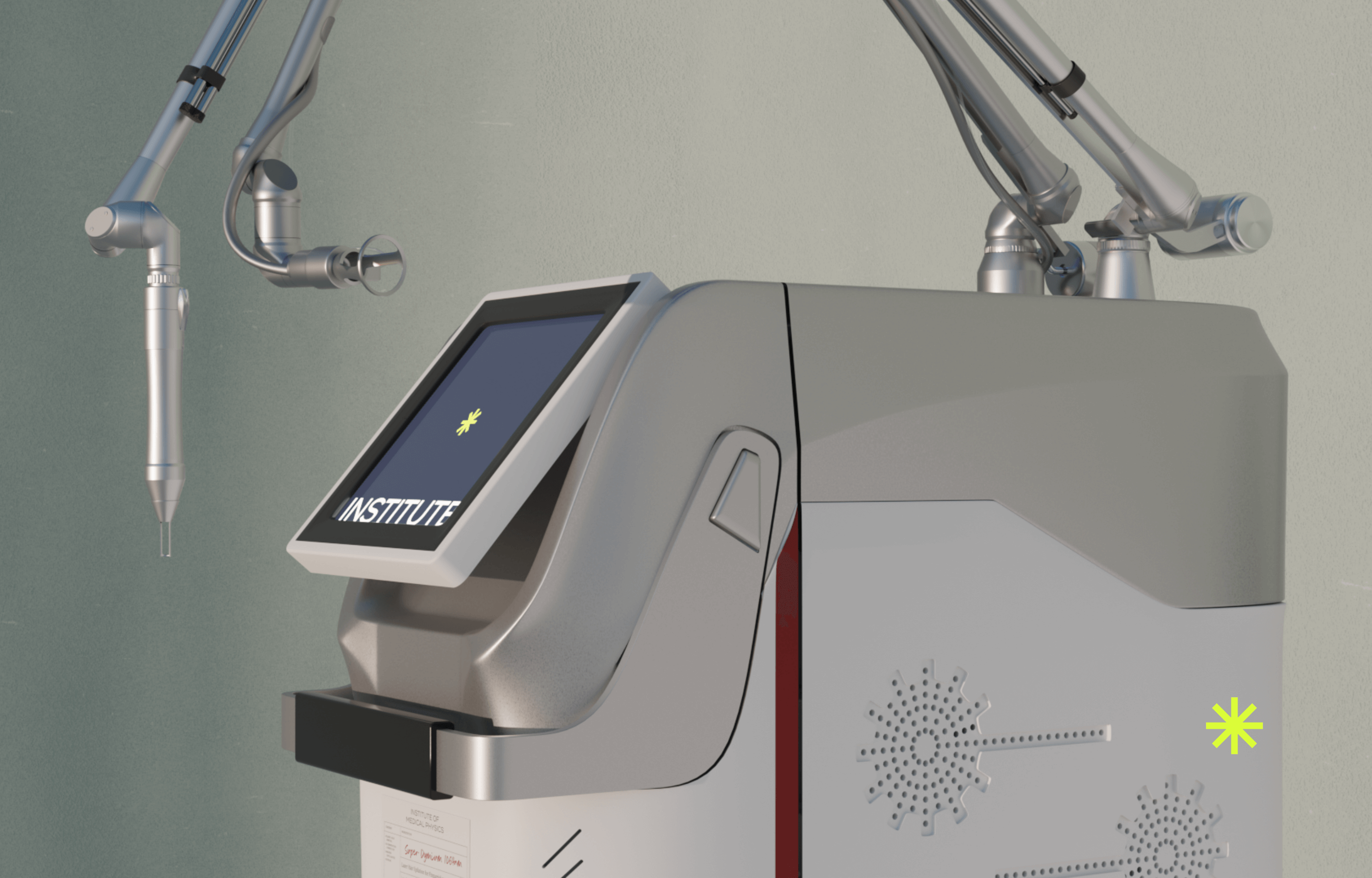
The Institute operates the Phantom™ system, a proprietary arsenal developed in our San Marino laboratory under Dr Emanuel Paleco. Phantom™ comprises eight distinct laser platforms covering nine therapeutic wavelengths, with a fastest pulse of 280 picoseconds and peak power of 2.79 gigawatts.
Within Phantom™-Pico, four picosecond architectures are used across a course. A sub-300 ps pulse generates the highest peak photoacoustic pressure for early, dense pigment, while a longer 750 ps pulse is more effective on residual, morphologically changed ink. Matching pulse duration to the stage of removal is why patients who stalled elsewhere see continued clearance at IMP.
What Is Subdermal Acoustic Imaging?
Subdermal acoustic imaging is a medical ultrasound scan of the tattoo performed before treatment. The Institute of Medical Physics is the only UK tattoo removal clinic that uses it as a standard part of every consultation.
The scan reveals four things a visual assessment cannot: ink depth and distribution, subsurface scar tissue (denser, hyperechoic areas often invisible to the naked eye), ink density variation, and subsurface changes from previous treatment elsewhere. Knowing what is actually beneath the skin lets the physician design a specific protocol rather than apply a generic one.
Can Tattoos on Scar Tissue Be Removed?
Yes, but scar tissue mechanically traps ink, so a tattoo on scarred skin often resists picosecond treatment alone. The Institute's CO₂ + Pico stacking protocol addresses both problems in the same session.
Fractional CO₂ creates microscopic channels through fibrotic tissue. Within a five-minute window, before the inflammatory cascade closes those channels, picosecond treatment is delivered through them, reaching ink that was previously inaccessible. The result is a double effect: treatment of the encapsulated ink, plus reduction of fibrosis and regeneration of the epithelial layer.
How Does Biological Therapy Speed Up Clearance?
Laser fragmentation is only half of removal. After a pulse shatters ink, macrophages must engulf the fragments and the lymphatic system must carry them away.
The Institute supplements every treatment with a biological therapy protocol that stimulates local macrophage activity, so more of each session's pigment is cleared before the next begins. The clinical consequence is shorter courses and a 4-week treatment interval that holds up under medical scrutiny.
What Should You Ask at a Tattoo Removal Consultation?
- Which laser systems do you operate, and what pulse durations and wavelengths do they deliver?
- Is treatment administered by a laser-specialised medical doctor, or is one on-site during the procedure?
- What reactions or adverse reactions should I expect after treatment?
- Are there any long-term adverse reactions?
- What size tattoo can I treat in a single session?
- What is your protocol if I develop blistering, hypopigmentation, or scarring, and can you treat those in-house?
- How will you adjust fluence for my Fitzpatrick skin type?
- Have you treated layered or previously failed tattoos before?
- What numbing options do you offer beyond cold air?
If the answers are vague, expect the treatment to be too.
Who Delivers Treatment at the Institute of Medical Physics?
Our tattoo removal programme is led by three doctors active at the Kings Cross clinic. Dr Emanuel Paleco, founder and scientific director, is a biophysicist who designed the Phantom™ system and has trained over 10,000 physicians globally. Dr Saif Abbas Chatoo, Medical Director, is a GMC-registered NHS physician at Royal Free London NHS Trust with an honorary research contract at UCL (GMC 8010191, verifiable on the GMC register). Dr Nikarika Prem delivers treatment sessions directly.
Every removal is administered by a doctor, never a beauty therapist or technician.
This guide is for general information and is not a substitute for a medical consultation. Suitability, session numbers, and outcomes vary by individual. Book a consultation with the team at the Institute of Medical Physics for an assessment of your tattoo and skin type.
This guide is for general information and is not a substitute for a medical consultation. Suitability, session numbers, and outcomes vary by individual. Book a consultation with the team at the Institute of Medical Physics for an assessment of your tattoo and skin type.
Related articles:
Frequently Asked Questions
How much does laser tattoo removal cost in London?
At the Institute of Medical Physics, laser tattoo removal costs a single upfront price based on tattoo size, starting at £750 for tattoos up to 5cm², with unlimited sessions over a 2-year period and monthly instalments available. A money-back guarantee applies if clearance is not achieved within the treatment period.
Does laser tattoo removal hurt?
There is discomfort, but it is brief. The sensation is comparable to an elastic band snapping against the skin, more intense over bony areas and milder on fleshier ones. Picosecond lasers cause noticeably less pain than older Q-switched systems. Cooled-air analgesia is used in every session, topical numbing in different strengths is available, and local injections can be administered by Dr Saif Chatoo.
Does laser tattoo removal leave scars?
Performed correctly, modern laser tattoo removal should not leave scars. Scarring almost always traces back to incorrect fluence for skin type, scarring from the original tattoo, or poor aftercare. The risk is meaningfully higher at non-medical clinics that cannot adjust fluence for darker skin tones.
How long should I wait between tattoo removal sessions?
Most clinics space sessions 6 to 8 weeks apart because they have no way to support immune clearance between visits. The Institute of Medical Physics treats every 4 weeks as standard because biological therapy accelerates clearance between sessions. This shorter interval is only clinically appropriate under direct medical supervision.
Can darker skin (Fitzpatrick IV-VI) be safely treated?
Yes, and it is one of the areas where the institute specialises. Many clinics decline Fitzpatrick types IV to VI because epidermal melanin competes with tattoo ink for laser absorption, raising the risk of burns, PIH, and hypopigmentation. The institute manages that risk with a 1064 nm primary wavelength, conservative fluences, and in-house 1927 nm Thulium and Excimer + Tacrolimus rescue protocols if complications emerge.
Is laser tattoo removal safe?
Laser tattoo removal is safe when delivered by a trained clinician using the correct wavelength and fluence for the patient's skin type. The published safety profile of picosecond lasers is strong. Safety drops sharply in non-medical clinics that cannot assess Fitzpatrick skin type accurately and adjust laser parameters accordingly.
Can a tattoo be completely removed?
Most black-ink, single-layer tattoos can be cleared completely with a full course of picosecond treatment. Some pigments, particularly white, pastel, and UV inks, may never fully clear, and layered or cosmetic tattoos need specialist assessment first. A pre-treatment ultrasound scan allows realistic expectations to be set before any laser is fired.
What aftercare does laser tattoo removal need?
Keep the area clean and dry for the first 48 to 72 hours, avoid swimming, hot tubs, and vigorous exercise during that window, and do not pick blisters or scabs. Protect the area from sun exposure with clothing or high-SPF sunscreen between sessions, and follow the specific aftercare instructions your treating doctor provides.

Tattoo Removal in London: The Complete Guide to Safe & Effective Laser Removal
.svg)

Quick Answer: Laser tattoo removal shatters ink with ultra-fast light pulses so your immune system can clear it naturally. With modern picosecond lasers under medical supervision, most tattoos clear in 4 to 8 sessions spaced 4 weeks apart. At the Institute of Medical Physics in Kings Cross, London, pricing starts at £750 upfront for unlimited sessions over 2 years.
The gap between what this technology can achieve and what most patients actually receive remains enormous, and that gap is where almost every poor outcome we see begins. This guide from the doctors at the Institute of Medical Physics sets out the clinical reality: how laser tattoo removal works, what it costs, how long it takes, and how to choose a London clinic that delivers genuinely good outcomes.
See our laser tattoo removal in London page for prices and bookings.
Written by Dr Saif Chatoo, MBBCh, B.Sc., Medical Director, GMC-registered physician (GMC 8010191).

Key Takeaways
- Modern picosecond lasers fire 1,000 times faster than older Q-switched systems, clearing most tattoos in 4 to 8 sessions instead of 10 to 20.
- Black ink clears fastest. Blue, green, layered, and cosmetic tattoos need specialist assessment and more sessions.
- Medical supervision matters: non-medical clinics in the UK operate outside CQC oversight, with documented risks of burns, hypopigmentation, and scarring.
- A single laser is rarely enough. Different pulse durations and wavelengths are needed at different stages, which is why single-system clinics often plateau early.
- Scarred skin and Fitzpatrick IV-VI tones need specialist protocols, including CO₂ + Pico stacking and conservative 1064 nm wavelength settings.
- Pricing structure reveals clinic incentives. A fixed upfront price with unlimited sessions aligns the clinic's interest with the patient's: the fastest possible clearance.
How Does Laser Tattoo Removal Work?
Laser tattoo removal works by selective photoacoustic thermolysis. lysis: a pulse of light lasting trillionths of a second shatters tattoo ink into fragments small enough for the immune system to clear, while leaving the surrounding skin largely untouched. That is why modern treatment can remove pigment without scarring.
Pulse duration is the variable that decides everything. Older Q-switched lasers fire in nanoseconds; modern picosecond systems fire roughly 1,000 times faster, fragmenting pigment far more efficiently.
A prospective trial published in JAMA Dermatology recorded greater than 75% clearance in 100% of completing patients after an average of 4.25 picosecond sessions, versus the 8.5 to 8.9 sessions historically required by Q-switched lasers. The same trial reported hypopigmentation in 20% and hyperpigmentation in 13% of patients at three months: a reminder that even best-in-class technology carries adverse-event rates an experienced clinician must manage.
Which Tattoos Can Be Removed with Laser?
Black, single-layer tattoos respond fastest, typically clearing in 4 to 6 sessions. Coloured, layered, cosmetic, and white or UV inks take longer or need specialist assessment before treatment begins.
NHS patient guidance confirms this pattern: according to Sandwell and West Birmingham NHS Trust, black, blue, and red pigments respond well, while green, yellow, and purple absorb laser energy less efficiently.
Layered tattoos are the most underestimated category. New ink absorbs laser energy first, leaving deeper pigment untouched, which is why patients with eight or more sessions elsewhere often arrive with substantial pigment remaining.
How Many Sessions Does Laser Tattoo Removal Take?
Most London clinics quote 10 to 20 sessions. At the Institute of Medical Physics in Kings Cross, complete clearance typically takes 4 to 8 sessions.
Three factors drive that difference: picosecond photoacoustic shattering produces smaller fragments that clear faster, biological therapy between sessions accelerates immune clearance, and a multi-system laser arsenal lets the physician adapt the protocol at every visit based on how the tattoo is actually responding.
How Much Does Laser Tattoo Removal Cost in London?
Most London clinics price tattoo removal per session, which means the clinic earns more the longer removal takes. The Institute of Medical Physics charges one fixed upfront price by tattoo size: from £750 for tattoos up to 5cm², covering unlimited sessions over a 2-year period (up to 24 monthly sessions), with monthly instalments available.
A money-back guarantee applies if clearance is not achieved within the treatment period. When a clinic earns more per extra session, the incentive to clear quickly disappears; a fixed-price model removes that conflict.
What Happens After Each Session? The Healing Timeline Week by Week
Recovery from a single session is more predictable than most patients expect when treatment is delivered correctly. Most skin settles within 4 weeks, which is when the next session can safely begin.
Tattoos on the lower legs and ankles, where circulation is slower, may take an extra two to three weeks to settle. Rushing schedules tighter than this rarely accelerates clearance and often raises the risk of pigmentary side effects.
Is Laser Tattoo Removal Safe? Why Doctor-Led Treatment Matters
Laser tattoo removal is safe when a trained clinician matches wavelength, pulse duration, and fluence to your skin type. Safety varies sharply by provider: the UK House of Commons Library confirms there are no specific controls on who can offer non-surgical cosmetic procedures in England, and most providers operate outside CQC oversight.
Documented risks at non-medical clinics include burns, hypopigmentation, paradoxical darkening, and scarring requiring corrective treatment. A specialised doctor-led setting changes four things in practice:
- Diagnostic accuracy before treatment: Fitzpatrick skin type, melanin density, prior scarring, and underlying dermatological conditions all alter correct laser settings. A non-medical operator working from a fixed protocol cannot adapt the way a clinician can.
- Real-time response to complications: Blistering, infection, and immune reactions are managed safely if recognised within minutes. Most non-medical clinics simply send the patient home.
- Correction of failed removals: A meaningful share of our caseload at the Kings Cross clinic is reconstructive, treating patients whose previous course of laser tattoo removal in London produced scarring or stalled clearance.
- Clear, scientific communication: Honest technical explanations and correct treatment expectations from the first consultation.
What If Something Goes Wrong? Treating Pigmentary Complications
Tattoo removal is not just about breaking down ink; a clinic must also be able to treat side effects when they occur. The Institute of Medical Physics uses a 1927nm Thulium laser protocol for post-inflammatory hyperpigmentation, with published efficacy in Fitzpatrick types IV-VI, and an Excimer + Tacrolimus protocol for hypopigmentation, combining the 308nm XeCI Excimer laser with a topical calcineurin inhibitor to stimulate repigmentation.
Patients who develop these reactions elsewhere come to us looking for a team with the technology and prescribing authority to reverse them.
Why Isn't One Laser Enough?
Different stages of removal need different pulse durations and wavelengths, so a clinic operating a single system will often plateau before clearance is complete. The laser arsenal a clinic operates tells you more about likely outcomes than any marketing claim.
Inside the Phantom™ System: Eight Platforms, Nine Wavelengths
The Institute operates the Phantom™ system, a proprietary arsenal developed in our San Marino laboratory under Dr Emanuel Paleco. Phantom™ comprises eight distinct laser platforms covering nine therapeutic wavelengths, with a fastest pulse of 280 picoseconds and peak power of 2.79 gigawatts.
Within Phantom™-Pico, four picosecond architectures are used across a course. A sub-300 ps pulse generates the highest peak photoacoustic pressure for early, dense pigment, while a longer 750 ps pulse is more effective on residual, morphologically changed ink. Matching pulse duration to the stage of removal is why patients who stalled elsewhere see continued clearance at IMP.
What Is Subdermal Acoustic Imaging?
Subdermal acoustic imaging is a medical ultrasound scan of the tattoo performed before treatment. The Institute of Medical Physics is the only UK tattoo removal clinic that uses it as a standard part of every consultation.
The scan reveals four things a visual assessment cannot: ink depth and distribution, subsurface scar tissue (denser, hyperechoic areas often invisible to the naked eye), ink density variation, and subsurface changes from previous treatment elsewhere. Knowing what is actually beneath the skin lets the physician design a specific protocol rather than apply a generic one.
Can Tattoos on Scar Tissue Be Removed?
Yes, but scar tissue mechanically traps ink, so a tattoo on scarred skin often resists picosecond treatment alone. The Institute's CO₂ + Pico stacking protocol addresses both problems in the same session.
Fractional CO₂ creates microscopic channels through fibrotic tissue. Within a five-minute window, before the inflammatory cascade closes those channels, picosecond treatment is delivered through them, reaching ink that was previously inaccessible. The result is a double effect: treatment of the encapsulated ink, plus reduction of fibrosis and regeneration of the epithelial layer.
How Does Biological Therapy Speed Up Clearance?
Laser fragmentation is only half of removal. After a pulse shatters ink, macrophages must engulf the fragments and the lymphatic system must carry them away.
The Institute supplements every treatment with a biological therapy protocol that stimulates local macrophage activity, so more of each session's pigment is cleared before the next begins. The clinical consequence is shorter courses and a 4-week treatment interval that holds up under medical scrutiny.
What Should You Ask at a Tattoo Removal Consultation?
- Which laser systems do you operate, and what pulse durations and wavelengths do they deliver?
- Is treatment administered by a laser-specialised medical doctor, or is one on-site during the procedure?
- What reactions or adverse reactions should I expect after treatment?
- Are there any long-term adverse reactions?
- What size tattoo can I treat in a single session?
- What is your protocol if I develop blistering, hypopigmentation, or scarring, and can you treat those in-house?
- How will you adjust fluence for my Fitzpatrick skin type?
- Have you treated layered or previously failed tattoos before?
- What numbing options do you offer beyond cold air?
If the answers are vague, expect the treatment to be too.
Who Delivers Treatment at the Institute of Medical Physics?
Our tattoo removal programme is led by three doctors active at the Kings Cross clinic. Dr Emanuel Paleco, founder and scientific director, is a biophysicist who designed the Phantom™ system and has trained over 10,000 physicians globally. Dr Saif Abbas Chatoo, Medical Director, is a GMC-registered NHS physician at Royal Free London NHS Trust with an honorary research contract at UCL (GMC 8010191, verifiable on the GMC register). Dr Nikarika Prem delivers treatment sessions directly.
Every removal is administered by a doctor, never a beauty therapist or technician.
This guide is for general information and is not a substitute for a medical consultation. Suitability, session numbers, and outcomes vary by individual. Book a consultation with the team at the Institute of Medical Physics for an assessment of your tattoo and skin type.
This guide is for general information and is not a substitute for a medical consultation. Suitability, session numbers, and outcomes vary by individual. Book a consultation with the team at the Institute of Medical Physics for an assessment of your tattoo and skin type.
Related articles:
Frequently Asked Questions
How much does laser tattoo removal cost in London?
At the Institute of Medical Physics, laser tattoo removal costs a single upfront price based on tattoo size, starting at £750 for tattoos up to 5cm², with unlimited sessions over a 2-year period and monthly instalments available. A money-back guarantee applies if clearance is not achieved within the treatment period.
Does laser tattoo removal hurt?
There is discomfort, but it is brief. The sensation is comparable to an elastic band snapping against the skin, more intense over bony areas and milder on fleshier ones. Picosecond lasers cause noticeably less pain than older Q-switched systems. Cooled-air analgesia is used in every session, topical numbing in different strengths is available, and local injections can be administered by Dr Saif Chatoo.
Does laser tattoo removal leave scars?
Performed correctly, modern laser tattoo removal should not leave scars. Scarring almost always traces back to incorrect fluence for skin type, scarring from the original tattoo, or poor aftercare. The risk is meaningfully higher at non-medical clinics that cannot adjust fluence for darker skin tones.
How long should I wait between tattoo removal sessions?
Most clinics space sessions 6 to 8 weeks apart because they have no way to support immune clearance between visits. The Institute of Medical Physics treats every 4 weeks as standard because biological therapy accelerates clearance between sessions. This shorter interval is only clinically appropriate under direct medical supervision.
Can darker skin (Fitzpatrick IV-VI) be safely treated?
Yes, and it is one of the areas where the institute specialises. Many clinics decline Fitzpatrick types IV to VI because epidermal melanin competes with tattoo ink for laser absorption, raising the risk of burns, PIH, and hypopigmentation. The institute manages that risk with a 1064 nm primary wavelength, conservative fluences, and in-house 1927 nm Thulium and Excimer + Tacrolimus rescue protocols if complications emerge.
Is laser tattoo removal safe?
Laser tattoo removal is safe when delivered by a trained clinician using the correct wavelength and fluence for the patient's skin type. The published safety profile of picosecond lasers is strong. Safety drops sharply in non-medical clinics that cannot assess Fitzpatrick skin type accurately and adjust laser parameters accordingly.
Can a tattoo be completely removed?
Most black-ink, single-layer tattoos can be cleared completely with a full course of picosecond treatment. Some pigments, particularly white, pastel, and UV inks, may never fully clear, and layered or cosmetic tattoos need specialist assessment first. A pre-treatment ultrasound scan allows realistic expectations to be set before any laser is fired.
What aftercare does laser tattoo removal need?
Keep the area clean and dry for the first 48 to 72 hours, avoid swimming, hot tubs, and vigorous exercise during that window, and do not pick blisters or scabs. Protect the area from sun exposure with clothing or high-SPF sunscreen between sessions, and follow the specific aftercare instructions your treating doctor provides.
By -
Dr. Saif Chatoo, MBBCh, B.Sc
May 18, 2026


