



Is Laser Tattoo Removal Safe? Doctor-Led Treatment and Side Effects

Is Laser Tattoo Removal Safe? Doctor-Led Treatment and Side Effects
Content of this Paper
↑
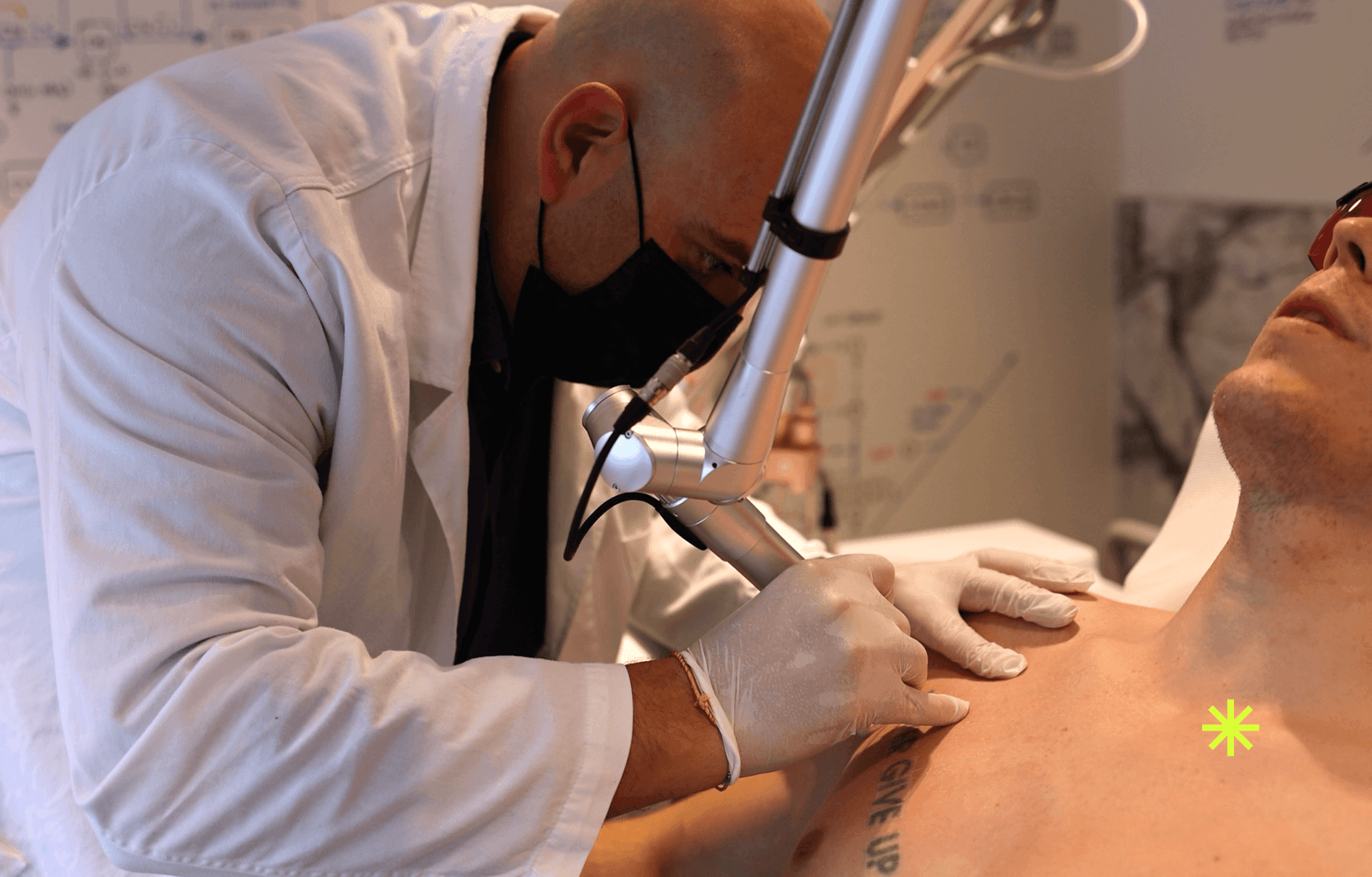
Laser tattoo removal is safe when it is performed by a trained clinician who matches wavelength, pulse duration and fluence to your skin type. Published data places the complication rate at roughly 8% of sessions, and the large majority of those events are temporary. The variable that decides your outcome is not the laser itself: it is who is holding it and whether they can treat a complication if one appears.
That distinction matters more in the UK than most patients realise, because demand for laser tattoo removal in London has outpaced the rules governing who may deliver it. At the Institute of Medical Physics in Kings Cross, a meaningful share of our caseload is corrective, meaning patients arrive with scarring, stalled clearance or pigment loss caused by a previous course elsewhere.
What follows is the clinical picture: what the published adverse event rates actually are, which side effects are expected, which are not, and what changes when treatment is delivered by a physician rather than a technician.
Already partway through a course, or worried about a reaction? Speak to a doctor at our Kings Cross St Pancras clinic before your next session, or read on.
Key Takeaways
- Laser tattoo removal is safe in trained hands. Practitioner-reported data puts complications at roughly 8.1% of sessions, and the large majority are temporary swelling or blistering rather than lasting damage.
- The spread in the literature is the real finding. Reported rates range from 2% to 50% for pigmentary change and 0% to 12% for scarring, which tells you operator competence and device class vary far more than the underlying biology does.
- Permanent outcomes are uncommon and largely avoidable. Hypertrophic scarring sits at around 0.2% of sessions and traces back to incorrect fluence for skin type, treating tattoos under twelve months old, or delivery by untrained operators.
- Know which reactions are not normal. Spreading redness after 72 hours, a blister over two centimetres, pallor persisting beyond eight weeks, or a raised ridge along the treated outline all need clinical review rather than a wait-and-see approach.
- Five groups carry higher risk: Fitzpatrick III and above, coloured tattoos, permanent make-up, previously treated work, and tattoos placed within the past year. None of these makes removal unsafe, but each makes a generic protocol unsafe.
- Picosecond technology is a better tool, not a risk-free one. A split-tattoo comparison showed no persistent adverse reaction on the picosecond side against typical hypopigmentation on the nanosecond side, yet a JAMA Dermatology trial still recorded hypopigmentation in 20% of patients at three months.
- UK licensing has not caught up with the technology. Section 180 powers exist, but the scheme is not yet in force, and 87.2% of practitioners report treating clients previously handled by untrained operators.
- Ask what happens when something goes wrong. The meaningful test of a clinic is whether it holds in-house rescue pathways, a 1927 nm Thulium protocol for hyperpigmentation and a 308 nm excimer with a topical calcineurin inhibitor for hypopigmentation, both of which need a prescriber on site.
What the Evidence Says About Laser Tattoo Removal Safety
The most useful recent dataset comes from a 2026 survey of trained practitioners published in Dermatology, which found that complications were reported in an estimated 8.1% of laser tattoo removal sessions. Patient-reported studies run higher, with one retrospective analysis recording 24.1%, and the wider literature shows enormous spread depending on device and protocol: 2% to 50% for pigmentary change, 0% to 50% for blistering, and 0% to 12% for scarring.
That spread is the real finding. It tells you that "is laser tattoo removal safe" has no single answer, because the technique, device class and operator competence vary far more than the biology does.
Normal Side Effects Versus Warning Signs
Immediately after a pulse, the treated area whitens. This is frosting, caused by gas released as ink fragments, and it settles within about 20 minutes. Redness, mild swelling, pinpoint bleeding and a sunburn-like sting for 24 to 48 hours all sit inside the expected range. Peeling begins around day four, and by week three the surface looks shiny before settling.
Four things fall outside that range and should trigger a call to your clinic rather than a wait-and-see approach: spreading redness with heat or discharge after 72 hours, which suggests infection; a blister larger than roughly two centimetres, which needs sterile management rather than self-treatment; skin that turns paler than the surrounding tissue and stays that way beyond eight weeks; and any raised, firm ridge forming along the treated outline, which is early hypertrophic scarring and is far easier to correct in week three than in month six.
Patients treated at the Institute have direct clinical access by WhatsApp between sessions, specifically so these decisions are made in hours rather than at the next appointment. Most side effects that become permanent do so because nobody looked at them early. Our full guidance on caring for your skin after laser tattoo removal covers the aftercare protocol in detail.
Which Factors Raise Your Risk
Risk is not evenly distributed across patients. In the same 2026 practitioner data, complications were reported significantly more often in five specific groups: Fitzpatrick skin types III and above, coloured tattoos, permanent make-up, tattoos that had already been treated elsewhere, and tattoos placed less than a year before treatment.
The mechanism differs in each case. In melanin-rich skin, epidermal melanin competes with tattoo ink for laser absorption, so energy intended for pigment is partly deposited in the epidermis. In permanent make-up and pale cosmetic inks, titanium dioxide and iron oxides can undergo chemical reduction when heated, which is why paradoxical darkening is documented most often in white, beige and flesh-toned pigments. Previously treated tattoos carry subsurface fibrosis that traps ink and alters how energy disperses.
None of these makes removal unsafe. Each one makes a generic protocol unsafe. This is precisely where a doctor-led tattoo removal London patient benefits from assessment rather than a fixed settings card, and it is why we scan before we treat. Subdermal acoustic imaging, a medical ultrasound of the tattoo performed at consultation, shows ink depth, density variation and hidden scar tissue that no visual assessment can detect. The Institute remains the only UK tattoo removal clinic using it as standard.
Why Pulse Duration Changes the Safety Profile
Selective photothermolysis works by depositing energy faster than the surrounding tissue can conduct heat away. Nanosecond Q-switched lasers deliver pulses long enough that heat spreads into adjacent tissue, which is the origin of most thermal injury, textural change and pigment loss in older removal courses.
A split-tattoo study in the Journal of the European Academy of Dermatology and Venereology treated halves of the same tattoo with nanosecond and picosecond pulses. The nanosecond side produced typical hypopigmentation, while the picosecond side produced no persistent adverse reaction, with mean pain scores of 5.8 for nanosecond, 4.9 for 1064 nm picosecond and 4.0 for 532 nm picosecond. A prospective trial in JAMA Dermatology recorded greater than 75% clearance in all completing patients after an average of 4.25 picosecond sessions, against the 8.5 to 8.9 sessions historically needed with Q-switched devices, though it still reported hypopigmentation in 20% and hyperpigmentation in 13% at three months.
That last figure is worth sitting with. Pico laser tattoo removal London providers frequently market picosecond technology as risk-free. It is not. It is a better tool with a narrower margin for error, which is why we run four separate picosecond architectures across a course: a sub-300 picosecond pulse for early, dense pigment where peak photoacoustic pressure matters most, and longer 750 picosecond pulses for residual ink that has already changed morphology. Fewer total sessions means less cumulative tissue exposure, and cumulative exposure is what drives pigmentary complications.
Why the Operator Matters More Than the Machine
In England, the legal position is still unresolved. Section 180 of the Health and Care Act 2022 created the power to license non-surgical cosmetic procedures, and the government confirmed a risk-tiered model in 2025, but as the House of Commons Library briefing sets out, the scheme is not yet in force. In practice, a laser capable of ablating tissue can currently be operated in a salon by someone with a weekend certificate.
The consequences show up in the data. Among practitioners who perform laser removal, 87.2% reported treating clients who had previously been treated by untrained operators, and 81.7% of those practitioners observed complications in that group, most commonly incomplete removal, hypopigmentation and hypertrophic scarring.
When you search for a London tattoo removal clinic, the question worth asking is not which device is in the room. It is what happens in the thirty seconds after something goes wrong. A physician can adjust fluence mid-session based on immediate tissue response, recognise an evolving type IV hypersensitivity reaction, and prescribe. A technician working from a protocol sheet can do none of these things. Our guide on choosing a laser tattoo removal clinic in London sets out the specific questions to put to any provider.
What Happens When a Complication Does Occur
Any clinic can quote a low complication rate. The meaningful test is whether it can reverse one. Tattoo removal specialists in London patients should be looking for the technology and the prescribing authority to treat the two pigmentary outcomes that concern people most.
For post-inflammatory hyperpigmentation, we use a 1927 nm Thulium laser protocol with published efficacy in Fitzpatrick IV to VI. For hypopigmentation, we combine the 308 nm XeCl excimer laser with a topical calcineurin inhibitor to stimulate repigmentation, a pairing that requires a prescriber on site. Where ink is trapped in existing scar tissue, a fractional CO₂ laser creates microchannels through the fibrosis, and picosecond energy is delivered through them inside a five-minute window before the inflammatory cascade closes those channels.
Safety also depends on interval discipline. Most clinics work at six to eight weeks because they have no way to support immune clearance between visits. We treat at four weeks because a biological therapy protocol stimulates local macrophage activity, so more of each session's fragmented pigment is cleared before the next pulse is delivered. Shorter courses, lower cumulative energy, fewer pigmentary events. Compressing intervals without that support simply stacks inflammation.
Practical Steps That Lower Your Own Risk
Some of the risk sits with you, and it is worth using.
Avoid sun exposure and self-tan for four weeks before every session, since a tanned epidermis raises melanin competition and forces a lower, less effective fluence. Declare isotretinoin use within the past six months, photosensitising medication, keloid history and any autoimmune skin condition at consultation rather than on the treatment day.
Do not book removal on a tattoo less than twelve months old, because fresh ink and a still-remodelling dermis both increase complication rates. Keep the area dry for 72 hours, leave blisters intact, and use high-factor SPF on the site throughout the course, not only in summer. Finally, photograph the area under consistent lighting after each session, which gives your clinician objective evidence of response rather than recall.
If you are weighing up laser tattoo removal near King's Cross, bring your previous treatment records if you have them. Knowing what wavelength and fluence you have already received changes what we can safely deliver on day one, and for any tattoo removal clinic London patients, the shortlist should be asking for those records before quoting a session count.
Speak to a Doctor Before You Book Anywhere
If you are considering removal, or you are already partway through a course that has stalled or caused a reaction, the useful next step is an assessment that includes your skin type, your ink chemistry and what is happening beneath the surface. Book a consultation at our Kings Cross St Pancras clinic and we will scan the area, review any previous treatment, and tell you plainly what is achievable. You can also read the full, complete guide to safe and effective tattoo removal in London or browse the wider tattoo removal research hub.
This guide is for general information and is not a substitute for a medical consultation. Suitability, session numbers, and outcomes vary by individual. Book a consultation with the team at the Institute of Medical Physics for an assessment of your tattoo and skin type.
This guide is for general information and is not a substitute for a medical consultation. Suitability, session numbers, and outcomes vary by individual. Book a consultation with the team at the Institute of Medical Physics for an assessment of your tattoo and skin type.
Related articles:
Frequently Asked Questions
Is laser tattoo removal safe?
Laser tattoo removal is safe when delivered by a trained clinician using the correct wavelength, pulse duration and fluence for the patient's skin type. Published practitioner data reports complications in approximately 8.1% of sessions, most commonly temporary swelling and blistering. Permanent outcomes such as scarring are reported in around 0.2% of sessions and are largely avoidable with correct settings.
What are the most common laser tattoo removal side effects?
The most common side effects are oedema in about 3.0% of sessions, blistering in 1.9%, and haematoma in 0.7%. Redness, frosting, mild swelling and pinpoint bleeding in the first 48 hours are expected rather than adverse. Pigmentary changes are less common, with hypopigmentation reported in 0.6% and hyperpigmentation in 0.5% of sessions.
Can laser tattoo removal cause permanent damage?
Permanent damage is uncommon but possible. Hypertrophic scarring is reported in roughly 0.2% of sessions, and hypopigmentation can become permanent if untreated. Both are strongly associated with incorrect fluence for the patient's Fitzpatrick skin type, treatment of very recent tattoos, and delivery by untrained operators. Early clinical review substantially improves the chance of full correction.
Is laser tattoo removal safe on dark skin?
Yes, when the protocol is adapted. Fitzpatrick types III and above show higher reported complication rates because epidermal melanin competes with tattoo ink for laser absorption. Safe treatment uses a 1064 nm primary wavelength, conservative fluences, longer test-patch assessment, and in-house rescue protocols for pigmentary change. Clinics without those capabilities frequently decline these skin types entirely.
Does laser tattoo removal hurt, and does pain indicate damage?
Discomfort is brief and comparable to an elastic band snapping against the skin. Pain intensity does not reliably indicate tissue damage. In a split-tattoo comparison, mean pain scores were 5.8 for nanosecond pulses, 4.9 for 1064 nm picoseconds and 4.0 for 532 nm picoseconds, with the nanosecond side producing more persistent pigment loss despite similar sensation.
How long do laser tattoo removal side effects last?
Swelling and redness typically settle within 24 to 72 hours. Blistering resolves over 7 to 14 days. Peeling begins around day four,, and the skin surface normalises by week three or four. Hyperpigmentation can persist for 3 to 12 months without treatment, and hypopigmentation may be permanent unless actively treated with repigmentation protocols.

Is Laser Tattoo Removal Safe? Doctor-Led Treatment and Side Effects
.svg)

Laser tattoo removal is safe when it is performed by a trained clinician who matches wavelength, pulse duration and fluence to your skin type. Published data places the complication rate at roughly 8% of sessions, and the large majority of those events are temporary. The variable that decides your outcome is not the laser itself: it is who is holding it and whether they can treat a complication if one appears.
That distinction matters more in the UK than most patients realise, because demand for laser tattoo removal in London has outpaced the rules governing who may deliver it. At the Institute of Medical Physics in Kings Cross, a meaningful share of our caseload is corrective, meaning patients arrive with scarring, stalled clearance or pigment loss caused by a previous course elsewhere.
What follows is the clinical picture: what the published adverse event rates actually are, which side effects are expected, which are not, and what changes when treatment is delivered by a physician rather than a technician.
Already partway through a course, or worried about a reaction? Speak to a doctor at our Kings Cross St Pancras clinic before your next session, or read on.

Key Takeaways
- Laser tattoo removal is safe in trained hands. Practitioner-reported data puts complications at roughly 8.1% of sessions, and the large majority are temporary swelling or blistering rather than lasting damage.
- The spread in the literature is the real finding. Reported rates range from 2% to 50% for pigmentary change and 0% to 12% for scarring, which tells you operator competence and device class vary far more than the underlying biology does.
- Permanent outcomes are uncommon and largely avoidable. Hypertrophic scarring sits at around 0.2% of sessions and traces back to incorrect fluence for skin type, treating tattoos under twelve months old, or delivery by untrained operators.
- Know which reactions are not normal. Spreading redness after 72 hours, a blister over two centimetres, pallor persisting beyond eight weeks, or a raised ridge along the treated outline all need clinical review rather than a wait-and-see approach.
- Five groups carry higher risk: Fitzpatrick III and above, coloured tattoos, permanent make-up, previously treated work, and tattoos placed within the past year. None of these makes removal unsafe, but each makes a generic protocol unsafe.
- Picosecond technology is a better tool, not a risk-free one. A split-tattoo comparison showed no persistent adverse reaction on the picosecond side against typical hypopigmentation on the nanosecond side, yet a JAMA Dermatology trial still recorded hypopigmentation in 20% of patients at three months.
- UK licensing has not caught up with the technology. Section 180 powers exist, but the scheme is not yet in force, and 87.2% of practitioners report treating clients previously handled by untrained operators.
- Ask what happens when something goes wrong. The meaningful test of a clinic is whether it holds in-house rescue pathways, a 1927 nm Thulium protocol for hyperpigmentation and a 308 nm excimer with a topical calcineurin inhibitor for hypopigmentation, both of which need a prescriber on site.
What the Evidence Says About Laser Tattoo Removal Safety
The most useful recent dataset comes from a 2026 survey of trained practitioners published in Dermatology, which found that complications were reported in an estimated 8.1% of laser tattoo removal sessions. Patient-reported studies run higher, with one retrospective analysis recording 24.1%, and the wider literature shows enormous spread depending on device and protocol: 2% to 50% for pigmentary change, 0% to 50% for blistering, and 0% to 12% for scarring.
That spread is the real finding. It tells you that "is laser tattoo removal safe" has no single answer, because the technique, device class and operator competence vary far more than the biology does.
Normal Side Effects Versus Warning Signs
Immediately after a pulse, the treated area whitens. This is frosting, caused by gas released as ink fragments, and it settles within about 20 minutes. Redness, mild swelling, pinpoint bleeding and a sunburn-like sting for 24 to 48 hours all sit inside the expected range. Peeling begins around day four, and by week three the surface looks shiny before settling.
Four things fall outside that range and should trigger a call to your clinic rather than a wait-and-see approach: spreading redness with heat or discharge after 72 hours, which suggests infection; a blister larger than roughly two centimetres, which needs sterile management rather than self-treatment; skin that turns paler than the surrounding tissue and stays that way beyond eight weeks; and any raised, firm ridge forming along the treated outline, which is early hypertrophic scarring and is far easier to correct in week three than in month six.
Patients treated at the Institute have direct clinical access by WhatsApp between sessions, specifically so these decisions are made in hours rather than at the next appointment. Most side effects that become permanent do so because nobody looked at them early. Our full guidance on caring for your skin after laser tattoo removal covers the aftercare protocol in detail.
Which Factors Raise Your Risk
Risk is not evenly distributed across patients. In the same 2026 practitioner data, complications were reported significantly more often in five specific groups: Fitzpatrick skin types III and above, coloured tattoos, permanent make-up, tattoos that had already been treated elsewhere, and tattoos placed less than a year before treatment.
The mechanism differs in each case. In melanin-rich skin, epidermal melanin competes with tattoo ink for laser absorption, so energy intended for pigment is partly deposited in the epidermis. In permanent make-up and pale cosmetic inks, titanium dioxide and iron oxides can undergo chemical reduction when heated, which is why paradoxical darkening is documented most often in white, beige and flesh-toned pigments. Previously treated tattoos carry subsurface fibrosis that traps ink and alters how energy disperses.
None of these makes removal unsafe. Each one makes a generic protocol unsafe. This is precisely where a doctor-led tattoo removal London patient benefits from assessment rather than a fixed settings card, and it is why we scan before we treat. Subdermal acoustic imaging, a medical ultrasound of the tattoo performed at consultation, shows ink depth, density variation and hidden scar tissue that no visual assessment can detect. The Institute remains the only UK tattoo removal clinic using it as standard.
Why Pulse Duration Changes the Safety Profile
Selective photothermolysis works by depositing energy faster than the surrounding tissue can conduct heat away. Nanosecond Q-switched lasers deliver pulses long enough that heat spreads into adjacent tissue, which is the origin of most thermal injury, textural change and pigment loss in older removal courses.
A split-tattoo study in the Journal of the European Academy of Dermatology and Venereology treated halves of the same tattoo with nanosecond and picosecond pulses. The nanosecond side produced typical hypopigmentation, while the picosecond side produced no persistent adverse reaction, with mean pain scores of 5.8 for nanosecond, 4.9 for 1064 nm picosecond and 4.0 for 532 nm picosecond. A prospective trial in JAMA Dermatology recorded greater than 75% clearance in all completing patients after an average of 4.25 picosecond sessions, against the 8.5 to 8.9 sessions historically needed with Q-switched devices, though it still reported hypopigmentation in 20% and hyperpigmentation in 13% at three months.
That last figure is worth sitting with. Pico laser tattoo removal London providers frequently market picosecond technology as risk-free. It is not. It is a better tool with a narrower margin for error, which is why we run four separate picosecond architectures across a course: a sub-300 picosecond pulse for early, dense pigment where peak photoacoustic pressure matters most, and longer 750 picosecond pulses for residual ink that has already changed morphology. Fewer total sessions means less cumulative tissue exposure, and cumulative exposure is what drives pigmentary complications.
Why the Operator Matters More Than the Machine
In England, the legal position is still unresolved. Section 180 of the Health and Care Act 2022 created the power to license non-surgical cosmetic procedures, and the government confirmed a risk-tiered model in 2025, but as the House of Commons Library briefing sets out, the scheme is not yet in force. In practice, a laser capable of ablating tissue can currently be operated in a salon by someone with a weekend certificate.
The consequences show up in the data. Among practitioners who perform laser removal, 87.2% reported treating clients who had previously been treated by untrained operators, and 81.7% of those practitioners observed complications in that group, most commonly incomplete removal, hypopigmentation and hypertrophic scarring.
When you search for a London tattoo removal clinic, the question worth asking is not which device is in the room. It is what happens in the thirty seconds after something goes wrong. A physician can adjust fluence mid-session based on immediate tissue response, recognise an evolving type IV hypersensitivity reaction, and prescribe. A technician working from a protocol sheet can do none of these things. Our guide on choosing a laser tattoo removal clinic in London sets out the specific questions to put to any provider.
What Happens When a Complication Does Occur
Any clinic can quote a low complication rate. The meaningful test is whether it can reverse one. Tattoo removal specialists in London patients should be looking for the technology and the prescribing authority to treat the two pigmentary outcomes that concern people most.
For post-inflammatory hyperpigmentation, we use a 1927 nm Thulium laser protocol with published efficacy in Fitzpatrick IV to VI. For hypopigmentation, we combine the 308 nm XeCl excimer laser with a topical calcineurin inhibitor to stimulate repigmentation, a pairing that requires a prescriber on site. Where ink is trapped in existing scar tissue, a fractional CO₂ laser creates microchannels through the fibrosis, and picosecond energy is delivered through them inside a five-minute window before the inflammatory cascade closes those channels.
Safety also depends on interval discipline. Most clinics work at six to eight weeks because they have no way to support immune clearance between visits. We treat at four weeks because a biological therapy protocol stimulates local macrophage activity, so more of each session's fragmented pigment is cleared before the next pulse is delivered. Shorter courses, lower cumulative energy, fewer pigmentary events. Compressing intervals without that support simply stacks inflammation.
Practical Steps That Lower Your Own Risk
Some of the risk sits with you, and it is worth using.
Avoid sun exposure and self-tan for four weeks before every session, since a tanned epidermis raises melanin competition and forces a lower, less effective fluence. Declare isotretinoin use within the past six months, photosensitising medication, keloid history and any autoimmune skin condition at consultation rather than on the treatment day.
Do not book removal on a tattoo less than twelve months old, because fresh ink and a still-remodelling dermis both increase complication rates. Keep the area dry for 72 hours, leave blisters intact, and use high-factor SPF on the site throughout the course, not only in summer. Finally, photograph the area under consistent lighting after each session, which gives your clinician objective evidence of response rather than recall.
If you are weighing up laser tattoo removal near King's Cross, bring your previous treatment records if you have them. Knowing what wavelength and fluence you have already received changes what we can safely deliver on day one, and for any tattoo removal clinic London patients, the shortlist should be asking for those records before quoting a session count.
Speak to a Doctor Before You Book Anywhere
If you are considering removal, or you are already partway through a course that has stalled or caused a reaction, the useful next step is an assessment that includes your skin type, your ink chemistry and what is happening beneath the surface. Book a consultation at our Kings Cross St Pancras clinic and we will scan the area, review any previous treatment, and tell you plainly what is achievable. You can also read the full, complete guide to safe and effective tattoo removal in London or browse the wider tattoo removal research hub.
This guide is for general information and is not a substitute for a medical consultation. Suitability, session numbers, and outcomes vary by individual. Book a consultation with the team at the Institute of Medical Physics for an assessment of your tattoo and skin type.
This guide is for general information and is not a substitute for a medical consultation. Suitability, session numbers, and outcomes vary by individual. Book a consultation with the team at the Institute of Medical Physics for an assessment of your tattoo and skin type.
Related articles:
Frequently Asked Questions
Is laser tattoo removal safe?
Laser tattoo removal is safe when delivered by a trained clinician using the correct wavelength, pulse duration and fluence for the patient's skin type. Published practitioner data reports complications in approximately 8.1% of sessions, most commonly temporary swelling and blistering. Permanent outcomes such as scarring are reported in around 0.2% of sessions and are largely avoidable with correct settings.
What are the most common laser tattoo removal side effects?
The most common side effects are oedema in about 3.0% of sessions, blistering in 1.9%, and haematoma in 0.7%. Redness, frosting, mild swelling and pinpoint bleeding in the first 48 hours are expected rather than adverse. Pigmentary changes are less common, with hypopigmentation reported in 0.6% and hyperpigmentation in 0.5% of sessions.
Can laser tattoo removal cause permanent damage?
Permanent damage is uncommon but possible. Hypertrophic scarring is reported in roughly 0.2% of sessions, and hypopigmentation can become permanent if untreated. Both are strongly associated with incorrect fluence for the patient's Fitzpatrick skin type, treatment of very recent tattoos, and delivery by untrained operators. Early clinical review substantially improves the chance of full correction.
Is laser tattoo removal safe on dark skin?
Yes, when the protocol is adapted. Fitzpatrick types III and above show higher reported complication rates because epidermal melanin competes with tattoo ink for laser absorption. Safe treatment uses a 1064 nm primary wavelength, conservative fluences, longer test-patch assessment, and in-house rescue protocols for pigmentary change. Clinics without those capabilities frequently decline these skin types entirely.
Does laser tattoo removal hurt, and does pain indicate damage?
Discomfort is brief and comparable to an elastic band snapping against the skin. Pain intensity does not reliably indicate tissue damage. In a split-tattoo comparison, mean pain scores were 5.8 for nanosecond pulses, 4.9 for 1064 nm picoseconds and 4.0 for 532 nm picoseconds, with the nanosecond side producing more persistent pigment loss despite similar sensation.
How long do laser tattoo removal side effects last?
Swelling and redness typically settle within 24 to 72 hours. Blistering resolves over 7 to 14 days. Peeling begins around day four,, and the skin surface normalises by week three or four. Hyperpigmentation can persist for 3 to 12 months without treatment, and hypopigmentation may be permanent unless actively treated with repigmentation protocols.
By -
Dr. Saif Chatoo, MBBCh, B.Sc
August 6, 2026


