



How to Choose the Right Laser Tattoo Removal Clinic in London

How to Choose the Right Laser Tattoo Removal Clinic in London
Content of this Paper
↑
Key Takeaways
- The clinic matters more than the laser brand. A device is only as good as the wavelengths it carries and the clinician matching each one to your ink, so the operator's judgement decides your outcome, not the logo on the machine.
- Doctor-led care changes results. Physician-led clinics can prescribe stronger pain relief, manage blistering or pigment change directly, and apply clinical reasoning to stalled or complex tattoos, none of which a non-medical salon can offer.
- One wavelength cannot clear every colour. Green and teal absorb best at 694 nm, a wavelength most single-platform picosecond lasers do not produce, so full-colour tattoos need a multi-wavelength system to clear rather than just fade.
- Skin tone is a safety issue, not a preference. Fitzpatrick IV to VI carry a real risk of hyper- or hypopigmentation if the wrong wavelength is used, making 1064 nm and proven pigment-correction protocols non-negotiable on darker skin.
- Your immune system does half the work. The laser fractures the ink, but macrophages clear it over the following weeks, which is why roughly four-week spacing and six to eight sessions beat any clinic promising clearance in two or three visits.
- Imaging and pricing reveal the real standard. Subdermal acoustic assessment plus direct clinical access signals a medical service, and fixed-price clearance aligns the clinic's incentive with your result instead of the number of appointments.
Choosing where to have a tattoo removed is a clinical decision, not a cosmetic one, even though the industry rarely frames it that way. A laser fragments pigment sitting one and a half to two millimetres below the surface of your skin; your immune system clears the debris over the following weeks, and the wavelength, pulse duration and operator judgement at every session decide whether you finish in six visits or stall at twenty.
Around 19% of British adults have a tattoo, and roughly 14% of them report some regret, according to a YouGov survey of British and American adults. If you are one of them, the clinic you pick will shape your result far more than any single marketing claim. This article focuses on that decision, what separates a genuine London tattoo removal clinic from a salon with a leased machine. It sits alongside the institute's complete guide to safe and effective tattoo removal in London, which covers the underlying science, healing and costs in full.
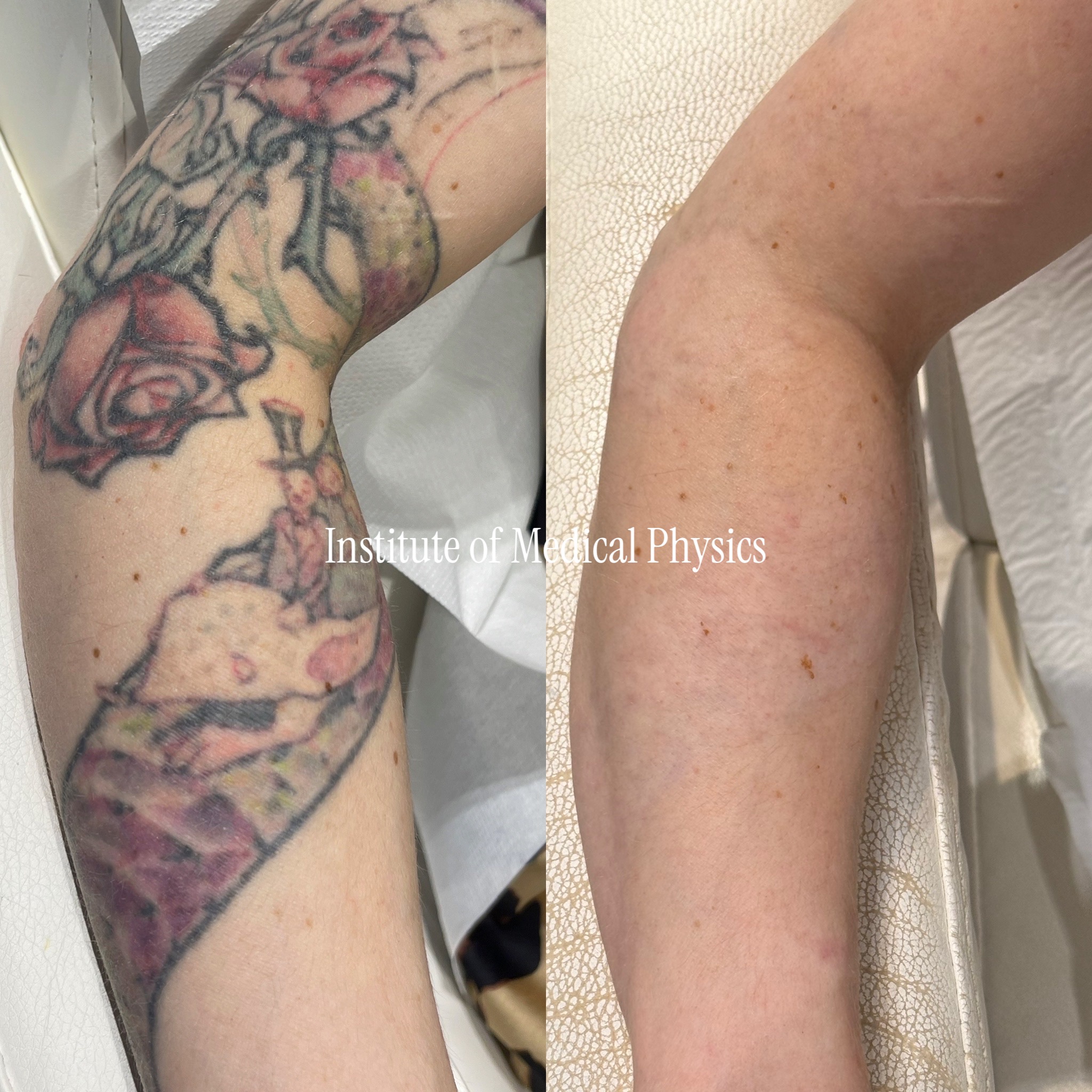
Why the Clinic Matters More Than the Laser Brand
Most people researching laser tattoo removal in London begin by comparing devices: PicoWay against PicoSure, nanosecond against picosecond. That is the wrong first question. A laser is only ever as capable as the wavelengths it carries and the clinician deciding how to use them. Every ink colour has an optical absorption peak, the precise wavelength at which it takes up energy most efficiently. Black absorbs broadly, which is why almost any device will lighten it.
Green and teal absorb most efficiently at 694 nm, a wavelength that most commercial picosecond platforms do not produce, which is why green ink is so often called impossible to remove. A clinic with a single device and two wavelengths will clear the colours it can target and leave everything else as a faint permanent shadow. The decision that genuinely determines your outcome is not which brand sits in the treatment room but whether a qualified person is matching the right wavelength to each pigment family and adjusting that choice as the ink breaks down across your course.
Doctor-Led or Therapist-Led: The Distinction That Changes Outcomes
The single most useful filter when comparing any London tattoo removal clinic is who actually delivers the treatment. In the UK, laser hair and tattoo work can legally be carried out by non-medical operators in many settings, which means a great deal of removal happens in beauty salons supervised by no clinician at all. That matters for three practical reasons.
First, pain management: a physician-led service can prescribe stronger relief, including cryogen cold air, 5% and prescription-strength 30% topical anaesthetics and local anaesthetic injections. Those stronger options are simply unavailable in non-medical settings, and pain is a common reason people abandon a course half-finished.
Second, complication handling: if you develop blistering, an unexpected pigment change or signs of infection, a doctor can assess and treat it directly rather than refer you elsewhere.
Third, judgement under uncertainty: a stalled tattoo, a cosmetic pigment that risks paradoxical darkening, or heavily saturated blackwork on darker skin all demand clinical reasoning, not a fixed protocol.
Doctor-led tattoo removal in London costs more to run and is therefore rarer, but it is the standard you want when ink sits permanently in your dermis. The institute's doctor-delivered laser tattoo removal service is built around that principle: removal is led by medical director Dr Saif Chatoo, a GMC-registered NHS physician at the Royal Free London (GMC 8010191), alongside lead removal physician Dr Nikarika Prem, with the same doctor seen at every visit.
The Technology Question: One Laser, or a Wavelength Arsenal?
Once medical oversight is established, the technology conversation becomes worth having. Laser tattoo removal works by selective photothermolysis, a principle first described in the journal Science in 1983 by Anderson and Parrish at Harvard: a pulse of light is chosen that the ink absorbs but the surrounding tissue largely does not, so the pigment shatters while the skin around it is spared.
The shorter the pulse, the more the mechanism shifts from heat-driven to pressure-driven, producing smaller fragments that your macrophages can carry away through the lymphatic system. This is why picosecond systems outperform older nanosecond lasers, and why conventional nanosecond removal has historically averaged eight to nine sessions for results that picosecond technology can often better in fewer sessions.
The table below sets out the three broad categories of tattoo removal technology, drawn from the published clinical literature catalogued in the StatPearls laser tattoo removal review.
A single-platform picosecond device is a genuine improvement on older lasers, but it carries a fixed wavelength set, so it physically cannot reach pigments outside its range. The Institute took a different route. Its Pico laser tattoo removal in London runs on a proprietary platform, Phantom, engineered by biophysicist Dr Emanuel Paleco in the institute's own San Marino laboratory rather than purchased off a catalogue.
It comprises eight laser systems covering nine wavelengths, with four distinct picosecond pulse architectures (200ps, 450ps, 600ps and 750ps) and a peak power of 4.19GW. The clinical point of that range is adaptability: dense fresh ink responds best to the fastest, highest-pressure pulse, while dispersed residual pigment late in a course interacts better with a longer architecture. No single fixed-platform laser can switch between the two.
Skin Tone, Pigment Change and Why It Is Non-Negotiable
If you have melanin-rich skin, the clinic you choose is not a matter of preference but of safety. Fitzpatrick skin types IV, V and VI carry a real risk of post-inflammatory hyperpigmentation and hypopigmentation when the wrong wavelength is used because the laser can target the melanin in your skin alongside the ink. This is precisely why many clinics decline darker skin tones outright or, worse, treat them anyway and cause lasting marks.
The safest wavelength for dense black ink on darker skin is 1064 nm, which passes more readily through melanin, and it demands an operator who understands the margin. Good tattoo removal specialists in London plan for pigment complications before they happen rather than reacting afterwards.
The institute manages post-inflammatory hyperpigmentation with a 1927 nm thulium laser and addresses hypopigmentation with an excimer and topical calcineurin inhibitor approach, both held in reserve as part of the treatment plan. If a clinic cannot explain how it would correct a pigment shift, it is not equipped to take the risk of causing one. Wavelength and skin tone interact in detail on the Institute's skin pigmentation treatment pages.
Sessions, Intervals and the Biology You Are Paying For
Reputable clinics are honest about this: the laser does roughly half the work; your immune system does the rest. Once a pulse fractures the ink, macrophages spend the following weeks transporting those fragments away, and the quality of that clearance is what separates a short course from an endless one. This is why session spacing is a clinical variable, not an administrative one.
The institute spaces sessions around four weeks apart, which gives the lymphatic system time to clear fragmented pigment before the next pass and supports that clearance with biological therapy between visits. For most patients this translates to roughly six to eight sessions, with full clearance often reached within about six months, a meaningfully faster trajectory than the eight-to-nine-session nanosecond average.
Be cautious of any tattoo removal clinic London offers that promises clearance in two or three sessions or books you in weekly: spacing sessions too tightly does not speed clearance, it only risks skin trauma without giving the biology time to work. Demand is rising: one peer-reviewed survey found 52.1% of tattooed adults interested in removing, covering or revising at least one tattoo, so clinics have every incentive to compress timelines. A clinic prioritising your skin will not.
What Good Assessment and Aftercare Actually Look Like
The strongest signal of a clinic worth trusting is what happens before the first pulse and between sessions. Most providers assess your tattoo by looking at it. The Institute uses subdermal acoustic imaging to scan beneath the skin first, mapping ink depth, ink density, scarring and tissue variation across the tattoo, none of which can be judged by eye. That data lets the doctors select the exact systems your tattoo needs rather than running a standard protocol and adapt the plan at each visit as the ink changes.
Aftercare access matters just as much. Redness and swelling after a session are normal signs the process is working, but you should never be left guessing. At the Institute every patient has direct WhatsApp clinical access to the doctors between appointments, so a concern reaches a physician rather than a receptionist. That combination, imaging-led planning and direct clinical access, is the working definition of laser tattoo removal near King's Cross done to a medical standard.
About the Institute of Medical Physics
The Institute of Medical Physics, founded by Dr Emanuel Paleco, is a premier medical laboratory specialising in medical and aesthetic laser science. With a flagship clinic in King’s Cross and additional locations in North London and Essex, the institute is at the forefront of laser science innovation.
Experience advanced laser science and innovative medical treatments. Book a consultation with Dr Emanuel Paleco and his expert team at the Institute of Medical Physics.
Frequently Asked Questions
How do I know if a London tattoo removal clinic is doctor-led?
Ask directly who delivers the treatment and check their registration. A doctor-led clinic will name a GMC-registered physician who performs or directly supervises every session, and that registration is verifiable on the public GMC register. If the clinic can only refer to "trained technicians" or a supervising doctor who is rarely on site, it is therapist-led, which limits both pain relief options and complication management.
Can all tattoo ink colours be removed by laser?
Yes, but only by a clinic carrying the right wavelengths. Each colour absorbs best at a specific wavelength: black broadly, red and orange at 532 nm, green and teal at 694 nm, and blue at 755 nm. A device with only one or two wavelengths cannot clear colours outside its range, so full-colour and multi-colour tattoos need a multi-wavelength system to clear completely rather than just fade.
How many sessions does laser tattoo removal take?
Conventional nanosecond lasers have historically averaged around eight to nine sessions. With a modern multi-architecture picosecond system and roughly four-week spacing, most patients need about six to eight sessions, with clearance often achieved within six months. The exact number depends on ink colour, density, depth, age of the tattoo and your skin's clearance response, which is why subdermal assessment matters.
Is laser tattoo removal safe for dark skin?
It can be, but only with the correct wavelength and clinical oversight. Fitzpatrick types IV to VI carry a genuine risk of hyperpigmentation or hypopigmentation if treated with the wrong settings. The 1064nm wavelength is the safest choice for dense black ink on darker skin. Choose a clinic that specialises in melanin-rich skin and can explain how it would correct a pigment change if one occurred.
Why is fixed-price, unlimited-session pricing better than paying per session?
Tattoo removal is hard to predict in advance, so per-session pricing exposes you to open-ended costs if your tattoo needs more visits than expected. A fixed price for full clearance aligns the clinic's incentives with your result rather than with the number of appointments and removes the pressure to stop before the ink is fully gone.
What should I ask at a tattoo removal consultation?
Ask who treats you, how many wavelengths the device carries, whether the tattoo is assessed beneath the skin first, what pain relief can be prescribed, whether pricing is fixed or per session, and what the plan is if your skin reacts. Clear, specific answers indicate a clinical service; vague or purely reassuring answers indicate a sales-led one.

How to Choose the Right Laser Tattoo Removal Clinic in London
.svg)

Key Takeaways
- The clinic matters more than the laser brand. A device is only as good as the wavelengths it carries and the clinician matching each one to your ink, so the operator's judgement decides your outcome, not the logo on the machine.
- Doctor-led care changes results. Physician-led clinics can prescribe stronger pain relief, manage blistering or pigment change directly, and apply clinical reasoning to stalled or complex tattoos, none of which a non-medical salon can offer.
- One wavelength cannot clear every colour. Green and teal absorb best at 694 nm, a wavelength most single-platform picosecond lasers do not produce, so full-colour tattoos need a multi-wavelength system to clear rather than just fade.
- Skin tone is a safety issue, not a preference. Fitzpatrick IV to VI carry a real risk of hyper- or hypopigmentation if the wrong wavelength is used, making 1064 nm and proven pigment-correction protocols non-negotiable on darker skin.
- Your immune system does half the work. The laser fractures the ink, but macrophages clear it over the following weeks, which is why roughly four-week spacing and six to eight sessions beat any clinic promising clearance in two or three visits.
- Imaging and pricing reveal the real standard. Subdermal acoustic assessment plus direct clinical access signals a medical service, and fixed-price clearance aligns the clinic's incentive with your result instead of the number of appointments.
Choosing where to have a tattoo removed is a clinical decision, not a cosmetic one, even though the industry rarely frames it that way. A laser fragments pigment sitting one and a half to two millimetres below the surface of your skin; your immune system clears the debris over the following weeks, and the wavelength, pulse duration and operator judgement at every session decide whether you finish in six visits or stall at twenty.
Around 19% of British adults have a tattoo, and roughly 14% of them report some regret, according to a YouGov survey of British and American adults. If you are one of them, the clinic you pick will shape your result far more than any single marketing claim. This article focuses on that decision, what separates a genuine London tattoo removal clinic from a salon with a leased machine. It sits alongside the institute's complete guide to safe and effective tattoo removal in London, which covers the underlying science, healing and costs in full.

Why the Clinic Matters More Than the Laser Brand
Most people researching laser tattoo removal in London begin by comparing devices: PicoWay against PicoSure, nanosecond against picosecond. That is the wrong first question. A laser is only ever as capable as the wavelengths it carries and the clinician deciding how to use them. Every ink colour has an optical absorption peak, the precise wavelength at which it takes up energy most efficiently. Black absorbs broadly, which is why almost any device will lighten it.
Green and teal absorb most efficiently at 694 nm, a wavelength that most commercial picosecond platforms do not produce, which is why green ink is so often called impossible to remove. A clinic with a single device and two wavelengths will clear the colours it can target and leave everything else as a faint permanent shadow. The decision that genuinely determines your outcome is not which brand sits in the treatment room but whether a qualified person is matching the right wavelength to each pigment family and adjusting that choice as the ink breaks down across your course.
Doctor-Led or Therapist-Led: The Distinction That Changes Outcomes
The single most useful filter when comparing any London tattoo removal clinic is who actually delivers the treatment. In the UK, laser hair and tattoo work can legally be carried out by non-medical operators in many settings, which means a great deal of removal happens in beauty salons supervised by no clinician at all. That matters for three practical reasons.
First, pain management: a physician-led service can prescribe stronger relief, including cryogen cold air, 5% and prescription-strength 30% topical anaesthetics and local anaesthetic injections. Those stronger options are simply unavailable in non-medical settings, and pain is a common reason people abandon a course half-finished.
Second, complication handling: if you develop blistering, an unexpected pigment change or signs of infection, a doctor can assess and treat it directly rather than refer you elsewhere.
Third, judgement under uncertainty: a stalled tattoo, a cosmetic pigment that risks paradoxical darkening, or heavily saturated blackwork on darker skin all demand clinical reasoning, not a fixed protocol.
Doctor-led tattoo removal in London costs more to run and is therefore rarer, but it is the standard you want when ink sits permanently in your dermis. The institute's doctor-delivered laser tattoo removal service is built around that principle: removal is led by medical director Dr Saif Chatoo, a GMC-registered NHS physician at the Royal Free London (GMC 8010191), alongside lead removal physician Dr Nikarika Prem, with the same doctor seen at every visit.
The Technology Question: One Laser, or a Wavelength Arsenal?
Once medical oversight is established, the technology conversation becomes worth having. Laser tattoo removal works by selective photothermolysis, a principle first described in the journal Science in 1983 by Anderson and Parrish at Harvard: a pulse of light is chosen that the ink absorbs but the surrounding tissue largely does not, so the pigment shatters while the skin around it is spared.
The shorter the pulse, the more the mechanism shifts from heat-driven to pressure-driven, producing smaller fragments that your macrophages can carry away through the lymphatic system. This is why picosecond systems outperform older nanosecond lasers, and why conventional nanosecond removal has historically averaged eight to nine sessions for results that picosecond technology can often better in fewer sessions.
The table below sets out the three broad categories of tattoo removal technology, drawn from the published clinical literature catalogued in the StatPearls laser tattoo removal review.
A single-platform picosecond device is a genuine improvement on older lasers, but it carries a fixed wavelength set, so it physically cannot reach pigments outside its range. The Institute took a different route. Its Pico laser tattoo removal in London runs on a proprietary platform, Phantom, engineered by biophysicist Dr Emanuel Paleco in the institute's own San Marino laboratory rather than purchased off a catalogue.
It comprises eight laser systems covering nine wavelengths, with four distinct picosecond pulse architectures (200ps, 450ps, 600ps and 750ps) and a peak power of 4.19GW. The clinical point of that range is adaptability: dense fresh ink responds best to the fastest, highest-pressure pulse, while dispersed residual pigment late in a course interacts better with a longer architecture. No single fixed-platform laser can switch between the two.
Skin Tone, Pigment Change and Why It Is Non-Negotiable
If you have melanin-rich skin, the clinic you choose is not a matter of preference but of safety. Fitzpatrick skin types IV, V and VI carry a real risk of post-inflammatory hyperpigmentation and hypopigmentation when the wrong wavelength is used because the laser can target the melanin in your skin alongside the ink. This is precisely why many clinics decline darker skin tones outright or, worse, treat them anyway and cause lasting marks.
The safest wavelength for dense black ink on darker skin is 1064 nm, which passes more readily through melanin, and it demands an operator who understands the margin. Good tattoo removal specialists in London plan for pigment complications before they happen rather than reacting afterwards.
The institute manages post-inflammatory hyperpigmentation with a 1927 nm thulium laser and addresses hypopigmentation with an excimer and topical calcineurin inhibitor approach, both held in reserve as part of the treatment plan. If a clinic cannot explain how it would correct a pigment shift, it is not equipped to take the risk of causing one. Wavelength and skin tone interact in detail on the Institute's skin pigmentation treatment pages.
Sessions, Intervals and the Biology You Are Paying For
Reputable clinics are honest about this: the laser does roughly half the work; your immune system does the rest. Once a pulse fractures the ink, macrophages spend the following weeks transporting those fragments away, and the quality of that clearance is what separates a short course from an endless one. This is why session spacing is a clinical variable, not an administrative one.
The institute spaces sessions around four weeks apart, which gives the lymphatic system time to clear fragmented pigment before the next pass and supports that clearance with biological therapy between visits. For most patients this translates to roughly six to eight sessions, with full clearance often reached within about six months, a meaningfully faster trajectory than the eight-to-nine-session nanosecond average.
Be cautious of any tattoo removal clinic London offers that promises clearance in two or three sessions or books you in weekly: spacing sessions too tightly does not speed clearance, it only risks skin trauma without giving the biology time to work. Demand is rising: one peer-reviewed survey found 52.1% of tattooed adults interested in removing, covering or revising at least one tattoo, so clinics have every incentive to compress timelines. A clinic prioritising your skin will not.
What Good Assessment and Aftercare Actually Look Like
The strongest signal of a clinic worth trusting is what happens before the first pulse and between sessions. Most providers assess your tattoo by looking at it. The Institute uses subdermal acoustic imaging to scan beneath the skin first, mapping ink depth, ink density, scarring and tissue variation across the tattoo, none of which can be judged by eye. That data lets the doctors select the exact systems your tattoo needs rather than running a standard protocol and adapt the plan at each visit as the ink changes.
Aftercare access matters just as much. Redness and swelling after a session are normal signs the process is working, but you should never be left guessing. At the Institute every patient has direct WhatsApp clinical access to the doctors between appointments, so a concern reaches a physician rather than a receptionist. That combination, imaging-led planning and direct clinical access, is the working definition of laser tattoo removal near King's Cross done to a medical standard.
About the Institute of Medical Physics
The Institute of Medical Physics, founded by Dr Emanuel Paleco, is a premier medical laboratory specialising in medical and aesthetic laser science. With a flagship clinic in King’s Cross and additional locations in North London and Essex, the institute is at the forefront of laser science innovation.
Experience advanced laser science and innovative medical treatments. Book a consultation with Dr Emanuel Paleco and his expert team at the Institute of Medical Physics.
Frequently Asked Questions
How do I know if a London tattoo removal clinic is doctor-led?
Ask directly who delivers the treatment and check their registration. A doctor-led clinic will name a GMC-registered physician who performs or directly supervises every session, and that registration is verifiable on the public GMC register. If the clinic can only refer to "trained technicians" or a supervising doctor who is rarely on site, it is therapist-led, which limits both pain relief options and complication management.
Can all tattoo ink colours be removed by laser?
Yes, but only by a clinic carrying the right wavelengths. Each colour absorbs best at a specific wavelength: black broadly, red and orange at 532 nm, green and teal at 694 nm, and blue at 755 nm. A device with only one or two wavelengths cannot clear colours outside its range, so full-colour and multi-colour tattoos need a multi-wavelength system to clear completely rather than just fade.
How many sessions does laser tattoo removal take?
Conventional nanosecond lasers have historically averaged around eight to nine sessions. With a modern multi-architecture picosecond system and roughly four-week spacing, most patients need about six to eight sessions, with clearance often achieved within six months. The exact number depends on ink colour, density, depth, age of the tattoo and your skin's clearance response, which is why subdermal assessment matters.
Is laser tattoo removal safe for dark skin?
It can be, but only with the correct wavelength and clinical oversight. Fitzpatrick types IV to VI carry a genuine risk of hyperpigmentation or hypopigmentation if treated with the wrong settings. The 1064nm wavelength is the safest choice for dense black ink on darker skin. Choose a clinic that specialises in melanin-rich skin and can explain how it would correct a pigment change if one occurred.
Why is fixed-price, unlimited-session pricing better than paying per session?
Tattoo removal is hard to predict in advance, so per-session pricing exposes you to open-ended costs if your tattoo needs more visits than expected. A fixed price for full clearance aligns the clinic's incentives with your result rather than with the number of appointments and removes the pressure to stop before the ink is fully gone.
What should I ask at a tattoo removal consultation?
Ask who treats you, how many wavelengths the device carries, whether the tattoo is assessed beneath the skin first, what pain relief can be prescribed, whether pricing is fixed or per session, and what the plan is if your skin reacts. Clear, specific answers indicate a clinical service; vague or purely reassuring answers indicate a sales-led one.
By -
Dr. Saif Chatoo, MBBCh, B.Sc
June 19, 2026


