



Does Laser Tattoo Removal Hurt? Pain vs Thermal Lasers
Does Laser Tattoo Removal Hurt? Pain vs Thermal Lasers
Content of this Paper
↑
Key Takeaways
- Laser tattoo removal causes brief bursts of sharp, hot discomfort, followed by warmth and tenderness that typically settles over the next 24–48 hours.
- Picosecond lasers use much shorter pulses than nanosecond systems, delivering energy faster and producing less heat in the surrounding skin.
- Pain varies by body area. Ribs, sternum, ankles, feet, hands, neck, and inner upper arm can feel more intense because the skin is thinner and closer to bone.
- Pain relief options include cold air, topical anaesthetic creams, prescription-strength numbing, and injected local anaesthetic.
- Later sessions may feel easier as less tattoo pigment remains to absorb laser energy, although previously scarred or aggressively treated skin can remain sensitive.
- Darker skin does not necessarily make tattoo removal more painful, but laser settings need to account for epidermal melanin to reduce the risk of burns and pigment changes.
- A clinical assessment can help match the laser settings and pain-management approach to the tattoo, skin type, ink depth, and existing scarring.
Yes, laser tattoo removal hurts, but only in short bursts, and modern picosecond lasers hurt measurably less than older heat-based systems. A 2025 meta-analysis of 21 trials in Lasers in Medical Science recorded average pain scores of 1.5 to 5.6 out of 10 for picosecond lasers, against 1.0 to 7.9 for nanosecond ones.
That gap is not down to luck or grit. It comes from how long each pulse lasts, because a longer pulse leaves heat behind in the skin around the ink, and heat is what your nerve endings report as pain. The laser on the trolley predicts your experience far more reliably than your pain threshold does.
Call the tattoo removal team at the Institute of Medical Physics on 0208 135 6968 to talk through numbing options before you book anything.
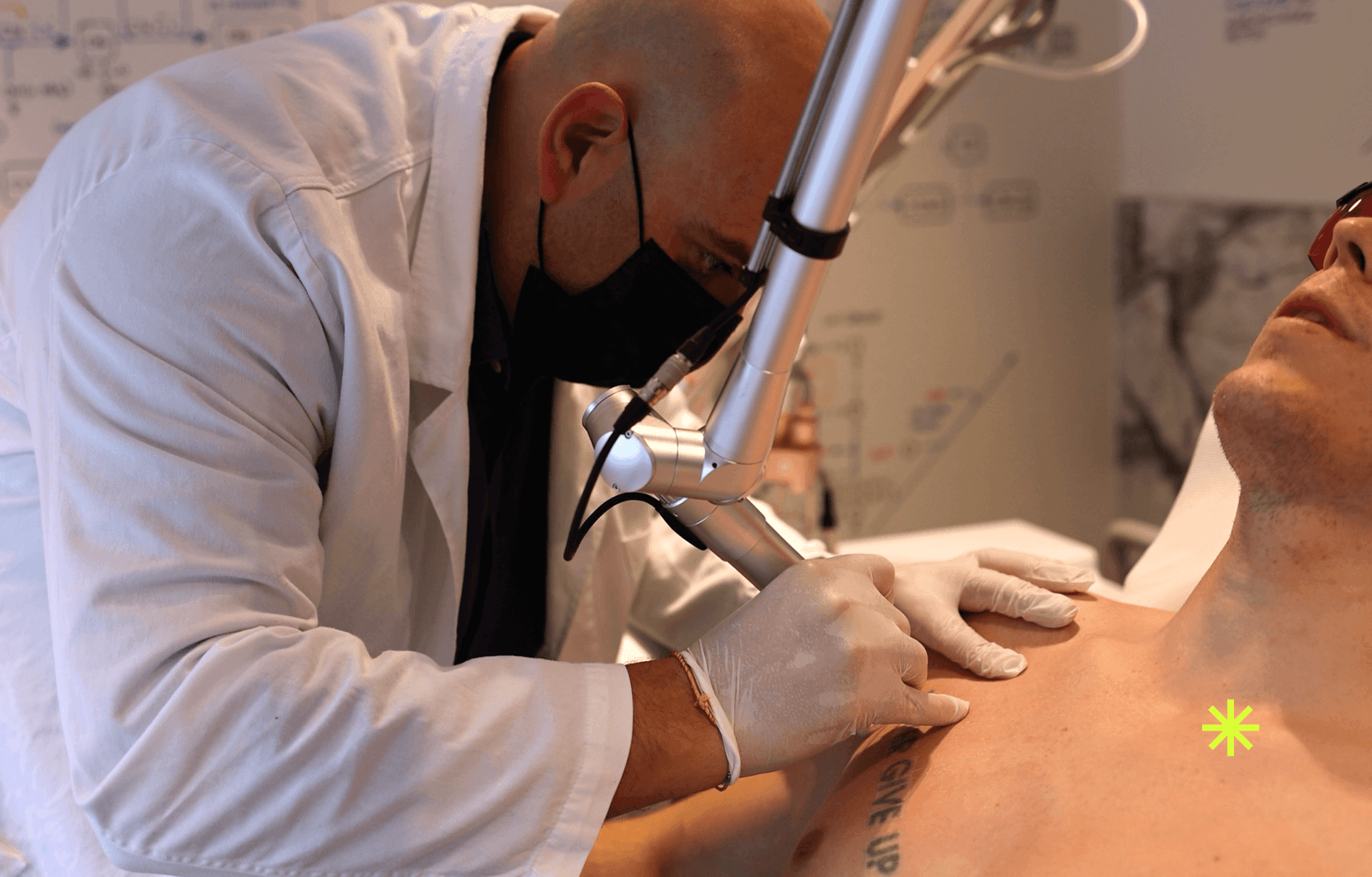
What does laser tattoo removal actually feel like?
Laser tattoo removal feels like a rapid series of sharp, hot flicks against the skin, each over in a fraction of a second, followed by warmth similar to mild sunburn for an hour or two.
Firing time is short. A small piece takes well under a minute of actual laser contact, so the sensation arrives in a burst rather than a long grind.
The skin turns white for a few minutes afterwards. That frosting is water vapour, not a burn, and it fades while you are still in the chair. Tenderness and swelling follow for a day or two, which is why how you care for the treated skin afterwards affects comfort as much as the session itself.
Why do thermal lasers hurt more than picosecond lasers?
Thermal lasers hurt more because their pulses last long enough for energy to spread outward as heat into the living tissue surrounding each ink particle.
Q-switched systems fire in nanoseconds, roughly 5 to 10 billionths of a second. That is quick, yet still slower than the time ink needs to shed heat, so the surrounding dermis warms up and your nerve endings register it.
Picosecond pulses are around a thousand times shorter. Energy lands faster than heat can move, so the ink shatters through a pressure wave instead of cooking. Less stray heat means less pain and less collateral injury.
A randomised split-tattoo trial published in Plastic and Reconstructive Surgery in February 2026 measured both. Patients reported lower pain on the picosecond side, and blistering occurred in 7.33% of picosecond sessions against 15.33% with the nanosecond laser, with bleeding at 2% against 8%.
Those complication numbers matter for comfort in the days afterwards, not just the minutes during. Fewer blisters means fewer sore dressings and fewer broken nights.
Which body areas hurt most, and why?
Thin skin stretched over bone hurts most, because nerve endings sit closer to the surface there and less soft tissue absorbs the acoustic pressure.
Ribs, sternum, ankles, the tops of the feet, the hands, the neck and the inner upper arm sit at the sharper end. The outer thigh, outer upper arm, back and calf sit at the gentler end.
A useful way to think about it: size predicts how long the discomfort lasts, and location predicts how intense it feels. A coin-sized tattoo on the ribs can feel worse in the moment than a full forearm piece, even though the forearm session runs far longer.
Which numbing options actually reduce the pain?
Injected local anaesthetic removes most of the sensation, while cold air and pharmacy-strength cream reduce it rather than remove it.
The difference is measurable. In a 2026 case series in Lasers in Medical Science, where every session began with infiltrated 2% lidocaine, half the patients reported no pain at all, and the rest scored it 2 out of 5.
Two rows on that table are prescription-only medicines. A beauty salon cannot legally supply them, which is the practical reason pain management differs so much between a clinic with a registered doctor and one without.
Does the pain change as the course goes on?
Most people find later sessions easier than the first, because there is less pigment left in the skin to absorb laser energy.
Dense, fresh, saturated ink soaks up the most energy per pulse, so the opening session tends to be the loudest one. As pigment disperses, settings are adjusted to match what is left, and the reaction drops with it.
Familiarity helps too. Anticipation drives a large part of how any brief procedure is experienced, and that falls away once you have sat through one.
Honesty about the exception: skin that already carries scarring, or that has been treated aggressively elsewhere, can stay sensitive across the course. Tell your clinician if a session felt sharper than the last one, because that is useful clinical information, not complaining.
Is tattoo removal painful on melanin-rich skin?
Removal does not have to hurt more on darker skin, but it is more often done badly, and poorly matched settings are both more painful and less safe.
Melanin in the epidermis competes with tattoo ink to absorb laser light. Push the energy up to compensate, and the top layer of skin takes the hit, which raises the risk of burns, post-inflammatory hyperpigmentation and pigment loss.
The safer route is a 1064 nm wavelength, conservative energy and a clinician who assesses your Fitzpatrick type before the first pulse rather than after a bad reaction. If you have skin of colour, ask specifically how many patients of your skin type the clinic treats each month.
How does the Institute of Medical Physics manage tattoo removal pain?
We treat pain as a clinical variable we control, not something you are asked to put up with. Because doctors run every session at our Kings Cross clinic, the full range is available: cryogen cold air, 5% topical numbing, prescription-strength 30% topical, and local anaesthetic injections where they are warranted.
The technology carries part of the load. Phantom™ was built in our own laboratory in San Marino by Dr Emanuel Paleco, and Phantom-Pico™ runs four picosecond pulse durations, the fastest at 200 picoseconds. Shorter pulses put pressure into the ink instead of heat into your skin.
Before anything fires, we scan beneath the surface to map ink depth, density and any existing scarring, so settings are matched to your tattoo rather than pulled from a fixed protocol. Our clinical guide explains how safe, effective clearance is planned from the first consultation.
Every removal at the Institute of Medical Physics is delivered by a doctor: Dr Saif Chatoo, our Medical Director and a GMC-registered NHS physician (GMC 8010191), and Dr Nikarika Prem, our lead removal physician. You see the same doctor each visit, and you can reach a physician directly between sessions.
Should pain stop you from starting tattoo removal?
No, pain should not stop you, because every part of it is manageable with the right laser and the right anaesthetic. The sensation is brief; it responds to numbing that a doctor can prescribe, and it eases as the ink clears. What deserves caution is a clinic that cannot adjust either variable for you.
Book a free consultation with the Institute of Medical Physics at 199 Kings Cross Road, London WC1X 9DB. Call 0208 135 6968 or email hello@medicalphysics.institute to discuss your tattoo and your pain relief options.
This guide is for general information and is not a substitute for a medical consultation. Suitability, session numbers, and outcomes vary by individual. Book a consultation with the team at the Institute of Medical Physics for an assessment of your tattoo and skin type.
Related articles:
Frequently asked questions
Is laser tattoo removal painful compared with getting the tattoo?
Most patients rate a removal session as sharper per second but far shorter overall than the tattoo appointment. A tattoo artist works the same area for hours; a laser pass over the same design takes seconds. Total discomfort is usually lower, even when the peak sensation feels more intense.
Can I take painkillers before a tattoo removal session?
Paracetamol taken an hour beforehand is generally acceptable and takes the edge off afterwards. Ask your treating clinician before taking anti-inflammatories such as ibuprofen or aspirin, since these can increase bruising and pinpoint bleeding. Avoid alcohol the night before, which raises both bleeding and light-headedness.
Does it hurt to remove a tattoo from the face or eyebrows?
Facial skin is thin and richly supplied with nerves, so cosmetic brow and lip pigment tends to feel sharper than body work. The treated area is also small, so sessions are brief. Topical numbing and eye shielding are standard, and a physician can inject local anaesthetic where needed.
How long does discomfort last after a session?
Expect warmth and tenderness for 24 to 48 hours, easing steadily from there. Swelling usually peaks around the second day. Discomfort that increases rather than settles after day two, or a blister large enough to be painful, should be reported to your clinic rather than waited out.
Is tattoo removal painful enough to need sedation?
Sedation is rarely needed for laser tattoo removal, even on large pieces. Injected local anaesthetic handles almost every case where topical numbing is not enough. If anxiety rather than pain is the obstacle, say so at consultation, because pacing, shorter treatment blocks and breaks are all workable adjustments.

Does Laser Tattoo Removal Hurt? Pain vs Thermal Lasers
.svg)

Key Takeaways
- Laser tattoo removal causes brief bursts of sharp, hot discomfort, followed by warmth and tenderness that typically settles over the next 24–48 hours.
- Picosecond lasers use much shorter pulses than nanosecond systems, delivering energy faster and producing less heat in the surrounding skin.
- Pain varies by body area. Ribs, sternum, ankles, feet, hands, neck, and inner upper arm can feel more intense because the skin is thinner and closer to bone.
- Pain relief options include cold air, topical anaesthetic creams, prescription-strength numbing, and injected local anaesthetic.
- Later sessions may feel easier as less tattoo pigment remains to absorb laser energy, although previously scarred or aggressively treated skin can remain sensitive.
- Darker skin does not necessarily make tattoo removal more painful, but laser settings need to account for epidermal melanin to reduce the risk of burns and pigment changes.
- A clinical assessment can help match the laser settings and pain-management approach to the tattoo, skin type, ink depth, and existing scarring.
Yes, laser tattoo removal hurts, but only in short bursts, and modern picosecond lasers hurt measurably less than older heat-based systems. A 2025 meta-analysis of 21 trials in Lasers in Medical Science recorded average pain scores of 1.5 to 5.6 out of 10 for picosecond lasers, against 1.0 to 7.9 for nanosecond ones.
That gap is not down to luck or grit. It comes from how long each pulse lasts, because a longer pulse leaves heat behind in the skin around the ink, and heat is what your nerve endings report as pain. The laser on the trolley predicts your experience far more reliably than your pain threshold does.
Call the tattoo removal team at the Institute of Medical Physics on 0208 135 6968 to talk through numbing options before you book anything.

What does laser tattoo removal actually feel like?
Laser tattoo removal feels like a rapid series of sharp, hot flicks against the skin, each over in a fraction of a second, followed by warmth similar to mild sunburn for an hour or two.
Firing time is short. A small piece takes well under a minute of actual laser contact, so the sensation arrives in a burst rather than a long grind.
The skin turns white for a few minutes afterwards. That frosting is water vapour, not a burn, and it fades while you are still in the chair. Tenderness and swelling follow for a day or two, which is why how you care for the treated skin afterwards affects comfort as much as the session itself.
Why do thermal lasers hurt more than picosecond lasers?
Thermal lasers hurt more because their pulses last long enough for energy to spread outward as heat into the living tissue surrounding each ink particle.
Q-switched systems fire in nanoseconds, roughly 5 to 10 billionths of a second. That is quick, yet still slower than the time ink needs to shed heat, so the surrounding dermis warms up and your nerve endings register it.
Picosecond pulses are around a thousand times shorter. Energy lands faster than heat can move, so the ink shatters through a pressure wave instead of cooking. Less stray heat means less pain and less collateral injury.
A randomised split-tattoo trial published in Plastic and Reconstructive Surgery in February 2026 measured both. Patients reported lower pain on the picosecond side, and blistering occurred in 7.33% of picosecond sessions against 15.33% with the nanosecond laser, with bleeding at 2% against 8%.
Those complication numbers matter for comfort in the days afterwards, not just the minutes during. Fewer blisters means fewer sore dressings and fewer broken nights.
Which body areas hurt most, and why?
Thin skin stretched over bone hurts most, because nerve endings sit closer to the surface there and less soft tissue absorbs the acoustic pressure.
Ribs, sternum, ankles, the tops of the feet, the hands, the neck and the inner upper arm sit at the sharper end. The outer thigh, outer upper arm, back and calf sit at the gentler end.
A useful way to think about it: size predicts how long the discomfort lasts, and location predicts how intense it feels. A coin-sized tattoo on the ribs can feel worse in the moment than a full forearm piece, even though the forearm session runs far longer.
Which numbing options actually reduce the pain?
Injected local anaesthetic removes most of the sensation, while cold air and pharmacy-strength cream reduce it rather than remove it.
The difference is measurable. In a 2026 case series in Lasers in Medical Science, where every session began with infiltrated 2% lidocaine, half the patients reported no pain at all, and the rest scored it 2 out of 5.
Two rows on that table are prescription-only medicines. A beauty salon cannot legally supply them, which is the practical reason pain management differs so much between a clinic with a registered doctor and one without.
Does the pain change as the course goes on?
Most people find later sessions easier than the first, because there is less pigment left in the skin to absorb laser energy.
Dense, fresh, saturated ink soaks up the most energy per pulse, so the opening session tends to be the loudest one. As pigment disperses, settings are adjusted to match what is left, and the reaction drops with it.
Familiarity helps too. Anticipation drives a large part of how any brief procedure is experienced, and that falls away once you have sat through one.
Honesty about the exception: skin that already carries scarring, or that has been treated aggressively elsewhere, can stay sensitive across the course. Tell your clinician if a session felt sharper than the last one, because that is useful clinical information, not complaining.
Is tattoo removal painful on melanin-rich skin?
Removal does not have to hurt more on darker skin, but it is more often done badly, and poorly matched settings are both more painful and less safe.
Melanin in the epidermis competes with tattoo ink to absorb laser light. Push the energy up to compensate, and the top layer of skin takes the hit, which raises the risk of burns, post-inflammatory hyperpigmentation and pigment loss.
The safer route is a 1064 nm wavelength, conservative energy and a clinician who assesses your Fitzpatrick type before the first pulse rather than after a bad reaction. If you have skin of colour, ask specifically how many patients of your skin type the clinic treats each month.
How does the Institute of Medical Physics manage tattoo removal pain?
We treat pain as a clinical variable we control, not something you are asked to put up with. Because doctors run every session at our Kings Cross clinic, the full range is available: cryogen cold air, 5% topical numbing, prescription-strength 30% topical, and local anaesthetic injections where they are warranted.
The technology carries part of the load. Phantom™ was built in our own laboratory in San Marino by Dr Emanuel Paleco, and Phantom-Pico™ runs four picosecond pulse durations, the fastest at 200 picoseconds. Shorter pulses put pressure into the ink instead of heat into your skin.
Before anything fires, we scan beneath the surface to map ink depth, density and any existing scarring, so settings are matched to your tattoo rather than pulled from a fixed protocol. Our clinical guide explains how safe, effective clearance is planned from the first consultation.
Every removal at the Institute of Medical Physics is delivered by a doctor: Dr Saif Chatoo, our Medical Director and a GMC-registered NHS physician (GMC 8010191), and Dr Nikarika Prem, our lead removal physician. You see the same doctor each visit, and you can reach a physician directly between sessions.
Should pain stop you from starting tattoo removal?
No, pain should not stop you, because every part of it is manageable with the right laser and the right anaesthetic. The sensation is brief; it responds to numbing that a doctor can prescribe, and it eases as the ink clears. What deserves caution is a clinic that cannot adjust either variable for you.
Book a free consultation with the Institute of Medical Physics at 199 Kings Cross Road, London WC1X 9DB. Call 0208 135 6968 or email hello@medicalphysics.institute to discuss your tattoo and your pain relief options.
This guide is for general information and is not a substitute for a medical consultation. Suitability, session numbers, and outcomes vary by individual. Book a consultation with the team at the Institute of Medical Physics for an assessment of your tattoo and skin type.
Related articles:
Frequently asked questions
Is laser tattoo removal painful compared with getting the tattoo?
Most patients rate a removal session as sharper per second but far shorter overall than the tattoo appointment. A tattoo artist works the same area for hours; a laser pass over the same design takes seconds. Total discomfort is usually lower, even when the peak sensation feels more intense.
Can I take painkillers before a tattoo removal session?
Paracetamol taken an hour beforehand is generally acceptable and takes the edge off afterwards. Ask your treating clinician before taking anti-inflammatories such as ibuprofen or aspirin, since these can increase bruising and pinpoint bleeding. Avoid alcohol the night before, which raises both bleeding and light-headedness.
Does it hurt to remove a tattoo from the face or eyebrows?
Facial skin is thin and richly supplied with nerves, so cosmetic brow and lip pigment tends to feel sharper than body work. The treated area is also small, so sessions are brief. Topical numbing and eye shielding are standard, and a physician can inject local anaesthetic where needed.
How long does discomfort last after a session?
Expect warmth and tenderness for 24 to 48 hours, easing steadily from there. Swelling usually peaks around the second day. Discomfort that increases rather than settles after day two, or a blister large enough to be painful, should be reported to your clinic rather than waited out.
Is tattoo removal painful enough to need sedation?
Sedation is rarely needed for laser tattoo removal, even on large pieces. Injected local anaesthetic handles almost every case where topical numbing is not enough. If anxiety rather than pain is the obstacle, say so at consultation, because pacing, shorter treatment blocks and breaks are all workable adjustments.
By -
Dr. Saif Chatoo, MBBCh, B.Sc
September 16, 2026


